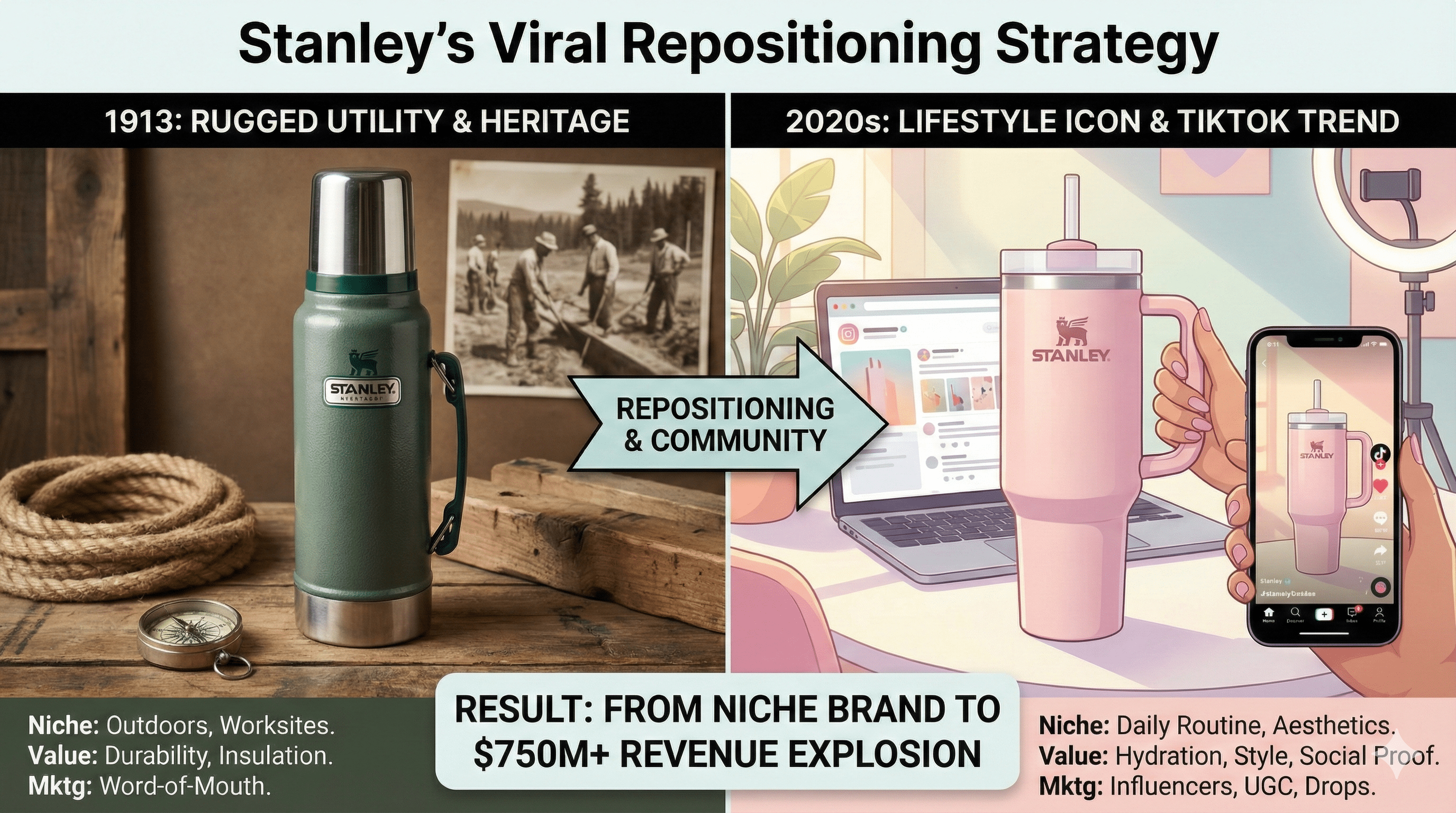
For more than a century, Stanley was a quiet workhorse brand: durable green thermoses trusted by outdoor workers, campers, and travelers, but rarely discussed in mainstream culture. The company, founded in 1913, built its reputation on reliability and insulation performance, not fashion or social media buzz. By the late 2010s, however, the drinkware market had exploded. Competitors like Hydro Flask and Yeti had captured younger consumers, reusable bottles had become style accessories, and social feeds were full of aesthetically pleasing tumblers and bottles. Stanley still had a great product—but it was playing the wrong role in a changed market.
Around 2016–2019, Stanley introduced the Quencher tumbler, a handled, straw-equipped stainless-steel cup intended mainly for hydration and outdoor use. Despite solid functionality, the product underperformed and was at risk of being discontinued because traditional wholesale partners did not see strong demand. At the same time, a new consumer behavior was emerging: mostly women documenting daily routines on Instagram and TikTok, with large, colorful tumblers appearing in “morning routine,” “car restock,” and “desk setup” content.
The functional benefit of “keeps drinks cold or hot for hours” had become table stakes in the insulated drinkware category; nearly every brand could claim it. The real battle was for relevance, identity, and cultural presence. Stanley’s heritage skewed older, more masculine, and outdoorsy, while the fastest-growing segments of the hydration market were driven by lifestyle, aesthetics, and social sharing. The challenge: how could a 110-year-old “dad brand” win in a world of TikTok trends and influencer hauls?
The Specific Tactic
Stanley’s breakthrough tactic was to reposition the Quencher around a new core audience (women, especially moms and lifestyle-focused consumers) and build demand through a tight partnership with a niche curator, The Buy Guide, before expanding via TikTok-fueled community and retail. Instead of leading with mass advertising or broad retail, Stanley leaned into:
- A focused collaboration with The Buy Guide, a women-run shopping and review platform with a highly engaged audience
- A product and color strategy tailored to everyday lifestyle use, not just outdoor adventures
- Heavy reliance on influencer and user-generated content, particularly on TikTok and Instagram, to normalize the Quencher as a daily accessory
- Scarcity, limited drops, and collectibles to create urgency and fandom
This was not simply “using social media.” It was a sequenced play: revive a nearly discontinued product through an influential niche partner, prove intense demand, then scale distribution and creator participation once the cultural spark caught.
The Insight
The key human insight was that hydration products had become visible identity markers and routine companions, not invisible tools. People, especially women in certain online communities, wanted a cup that:
- Fit into their real daily life (car cup holders, strollers, work desks)
- Matched their aesthetic (color-coordinated with outfits, bags, and home decor)
- Signaled membership in a micro-community (“the cup everyone in my circle has”)
The Buy Guide team—three female content creators—recognized that the Quencher, with its large volume, handle, and straw, solved real daily problems for their audience. In 2019, when they heard the Quencher might be discontinued, they persuaded Stanley to let them buy 10,000 units and sell them directly to their followers. Those units sold out in days, demonstrating that in the right segment, demand was far greater than traditional retail signals suggested.
Another behavioral insight: consumers increasingly discovered and validated products through trusted curators and peer creators, not brand-driven campaigns. If the “right” people online obsessed over this cup, their followers would too. Social proof within a tight-knit community could then spill over into the broader culture.
The Execution
The execution unfolded in deliberate phases, each with specific marketing moves.
1. The Buy Guide partnership and re-launch
- The Buy Guide had been organically promoting the Quencher as a favorite long before the relaunch, and their audience struggled to find it as stocks dwindled.
- In 2019, they negotiated to purchase thousands of nearly discontinued Quenchers directly from Stanley—reports vary between 5,000 and 10,000 units—so they could sell them via their platform.
- The initial drop sold out quickly, validating the product–audience fit and demonstrating that a women-focused lifestyle segment valued this “industrial” tumbler far more than legacy channels suggested.
- Importantly, The Buy Guide framed the cup not as a camping accessory but as an everyday hydration essential for busy women, using storytelling, curated photography, and affiliate links.
This reframing shifted the Quencher from “gear” to “lifestyle object” in the minds of a new demographic.
2. Design, colors, and “hydration meets aesthetics”
- Stanley leadership, including Terence Reilly (a former Crocs CMO), saw that focusing on “hydration, color revolution, and meeting consumer lifestyle” could be the backbone of a new strategy.
- The Quencher’s form—40 oz size, handle, straw, tapered base to fit car cup holders—matched daily routines: long drives, school runs, desk work, and gym time.
- Stanley introduced new colorways aligned with lifestyle trends: pastels, neutrals, and seasonal shades that felt more like fashion than camping gear.
- Limited-edition drops, including collaborations such as Stanley x Starbucks seasonal releases, further cemented the Quencher as a collectible, not just a utility item.
By designing—and merchandising—the Quencher as something people would enjoy seeing in photos and videos, Stanley amplified its on-camera appeal.
3. TikTok, influencers, and community content
- TikTok became a central amplifier. Content around Stanley cups—including “#StanleyTumbler” and related tags—amassed hundreds of millions to over a billion views as of 2023–2024.
- Creators posted “restock my Stanley,” “what’s in my cup,” “Stanley cup collection,” and morning routine videos where the Quencher was a recurring visual prop.
- Influencer endorsements—from lifestyle creators to celebrities like Adele—added legitimacy and aspiration.
- Fans decorated cups with stickers, shared organizational hacks (like special shelves for their tumblers), and compared colorways, turning ownership into a hobby.
Stanley did not just push influencer campaigns; it encouraged and amplified organic community behavior, reposting UGC and engaging in TikTok trends like “What’s in my bag?” and styling challenges.
4. Scaling retail—with demand already on fire
- After the Quencher had clear traction with The Buy Guide audience and across social media, Stanley expanded placement in major retailers such as Target, Costco, Walmart, and others.
- High demand led to frequent sell-outs and even purchase limits in some stores, which became content in itself as customers filmed frenzied in-store grabs and empty shelves.
- Viral videos—including one showing shoppers rushing to grab limited-edition Stanley x Starbucks Valentine’s cups at Target—reinforced the perception that these tumblers were scarce, desirable, and culturally “hot.”
Retail wasn’t just a sales channel; it was a stage for more viral moments.
5. Responding to viral moments and reinforcing brand narrative
- One widely covered incident involved a woman whose car caught fire; a video showed her Stanley tumbler intact, with ice still inside. The clip went viral on TikTok.
- Stanley’s CEO responded publicly, offering to replace not just the cup but the entire car, reinforcing both product durability and brand generosity.
- This response generated significant earned media and further positive sentiment, fitting into a narrative of Stanley as both reliable and culturally aware.
Stanley showed an ability to read the social moment and react in a way that enhanced the story rather than ignoring it.
The Result
The numbers illustrate how powerful this repositioning and community-led approach became:
- Stanley’s annual revenue climbed from roughly $70–75 million in 2019 to about $750 million in 2023, driven primarily by the Quencher line.
- Some analyses estimate a roughly 10x increase in sales over four years, or about an additional $700 million in revenue since the new strategy took off.
- Hashtags and content around the Stanley tumbler generated massive engagement, with #StanleyTumbler reportedly crossing into the hundreds of millions to over a billion views on TikTok.
- The Quencher became Stanley’s top-selling product and significantly increased its market share in the reusable water bottle segment.
- Demographically, the brand expanded from a niche outdoor and worksite audience to a much broader base of younger, lifestyle-oriented consumers, particularly women.
For a marketing student, these metrics show how positioning, community, and distribution strategy can transform a mature brand far beyond what incremental advertising typically achieves.
Why it Worked
Several core marketing principles made Stanley’s approach successful, and all are transferable to other brands—even in “boring” categories.
1. Re-egmentation and repositioning, not reinvention
Stanley did not need to invent a new technology. Instead, it re-segmented the existing hydration market by focusing on a specific, under-served use case and demographic: women who wanted a high-capacity, aesthetically pleasing, convenient cup that fit into their highly documented daily routines.
- The “job to be done” shifted from “keep my coffee hot on a worksite” to “be my all-day hydration companion that looks good on my counter, desk, and feed.”
- The brand story moved from rugged utility to lifestyle reliability, while still leveraging the credibility of a 110-year heritage.
Transferable principle for students: Before trying to create entirely new products, ask where existing strengths could win with a different segment or use case. Many “boring” products can be repositioned if you change who they are for and what role they play in modern life.
2. Distribution as a signal, not just a channel
Choosing The Buy Guide as the initial flagship partner, rather than a big-box chain, signaled that the Quencher was a curated “find” within a trusted community. Early scarcity and affiliate-driven sales created social proof and urgency before mass retailers got involved.
Transferable principle: How and where a product first appears tells the market what kind of product it is. Launching through tastemaker channels or niche communities can create perceived specialness that later justifies broader distribution.
3. Designing for visibility and social proof
The Quencher’s design choices—size, handle, straw, and especially color—made it a highly visible prop in photos and videos. On TikTok, the cup’s silhouette and shades were instantly recognizable, turning every piece of content into a subtle ad and social proof.
Transferable principle: In a visual-first media environment, products that “read” clearly on camera have an advantage. When designing or selecting products, marketers should consider on-camera distinctiveness as a strategic asset, not an afterthought.
4. Community rituals and collectibility
Limited drops, seasonal colorways, and collaborations (e.g., with Starbucks) encouraged collection behavior. Fans showcased entire lines of Stanleys, ranked colorways, and created rituals around restocking and organizing their cups.
Transferable principle: Even mundane products can become “collectible” if brands introduce variations, scarcity, and rituals. This increases lifetime value and creates ongoing conversation instead of one-off purchases.
5. Heritage as proof, not a prison
Stanley’s 110-year history could have trapped it in a narrow “rugged outdoors” identity, but leadership used that legacy to underline durability and trust while embracing a totally new aesthetic and audience.
Transferable principle: Legacy brands are not obligated to keep telling the same story. Heritage can be repositioned as evidence (“we’ve been doing this forever”) while the front-facing narrative adapts to contemporary culture.
How students can apply this
To use the Stanley case as study material and a template:
- Case exercise 1 – Reposition a legacy product:
Pick a long-standing product (e.g., an office chair brand, a household cleaner, or a B2B tool).- Define a new segment or use case where that product could be reframed as a lifestyle, identity, or workflow object.
- Outline a partnership strategy with a niche curator or platform similar to The Buy Guide in that category.
- Case exercise 2 – Design for on-camera culture:
Take a “boring” product and redesign its packaging, color, or form so it becomes visually distinctive in short-form video. Explain how that would change your TikTok/Instagram content plan. - Case exercise 3 – Map the rollout sequence:
Sketch a launch timeline that mirrors Stanley’s sequence:- community partner launch;
- UGC and influencer amplification;
- retail expansion;
- reacting to viral moments with brand-building responses.
The overarching, teachable marketing principle is: Reframing a familiar product for a new cultural role—through targeted distribution, creator-led storytelling, and on-camera design—can unlock exponential growth without massive ad budgets. For marketing students, the Stanley story is a reminder to look beyond “what campaign should we run?” and ask “what community, context, and identity could this product belong to if we told a different story?”
Resources
- Collins, M. (2024, January 5). Stanley Cup craze floods TikTok feeds, raises $750 million in revenue. Forbes. https://www.forbes.com/sites/marcuscollins/2024/01/05/stanley-cup-craze-floods-tiktok-feeds-raises-750-million-in-revenue/[forbes]
- DiPlacido, D. (2024, January 29). TikTok’s Stanley Cup craze has hit a wall — of lead. Forbes. https://www.forbes.com/sites/danidiplacido/2024/01/29/stanley-cup-tiktok-craze-has-hit-a-wall---of-lead/[forbes]
- Jansen, C. (2025, January 5). The story of the cup. The Buy Guide. https://thebuyguide.com/home/the-story-of-the-cup/[thebuyguide]
- Murray, C. (2024, January 3). Why are Stanley cups trending on TikTok? The water bottle craze racks up millions in sales. Forbes. https://www.forbes.com/sites/conormurray/2024/01/03/why-is-tiktok-obsessed-with-stanley-cups-the-water-bottle-craze-racks-up-millions-in-sales/[forbes]
- Rival IQ. (2024, May 5). How Stanley’s marketing strategy went viral. Rival IQ Blog. https://www.rivaliq.com/blog/stanleys-marketing-strategy/[rivaliq]
- Sekol, M. (2024, January 8). When Ashlee met Stanley. The ESG Advocate (Substack). https://esgadvocate.substack.com/p/when-stanley-met-ashlee[esgadvocate.substack]
- Teak Media. (2024, January 23). PR lessons from the Stanley Cup craze. Teak Media. https://teakmedia.com/blog/pr-lessons-from-the-stanley-cup-craze/[teakmedia]
- Vimmi. (2025, September 17). Shoppable video: How Stanley 1913 became a viral lifestyle brand. Vimmi Blog. https://vimmi.net/blog/shoppable-videos-stanley-1913-case-study/[vimmi]
- Kwik. (2024, January 29). The science behind Stanley’s $700M viral sales boost. Kwik. https://kwik.com/the-science-behind-stanleys-700m-viral-sales-boost/[kwik]
- Studio Sunup. (2024, December 9). Stanley’s brand reinvention: A marketing masterclass. Studio Sunup. https://studiosunup.com/blog/stanley-branding-success/[studiosunup]
- Meltwater. (2025, December 9). The Stanley Cup craze — a social listening analysis. Meltwater. https://www.meltwater.com/en/blog/stanley-cup-marketing-case-study[meltwater]
- Quinnipiac University. (2024, January 8). Stanley drinkware sensation offers a vivid example of the power of social media and PR. Quinnipiac Today. https://www.qu.edu/quinnipiac-today/stanley-cups-ride-the-wave-of-tiktok-popularity-2024-01-09/[qu]
- Oklahoma State University. (2024, April 16). The rise of Stanley: A marketing success story (Honor’s thesis PDF). Oklahoma State University Open Research. https://openresearch.okstate.edu/bitstreams/17308e76-2328-4b1a-999c-641a6488b9bb/download[openresearch.okstate]


.png)