Glossier did not start as a beauty company. It started as a conversation. Before there were products, stores, or campaigns, there was a blog called Into The Gloss where founder Emily Weiss interviewed “cool girls” about their skincare and makeup routines and asked readers what they loved, what they hated, and what felt missing. That blog became a live focus group and community years before Glossier launched its first product in 2014. Instead of hiring big agencies to build a brand from the top down, Glossier turned that community’s comments, DMs, and selfies into its product roadmap, its visual identity, and its marketing strategy. The result: a direct-to-consumer beauty brand that reached unicorn status (valued at around $1.2 billion by 2019) and reshaped how modern beauty marketing works.
Market Context: Top-Down Beauty In A Social Era
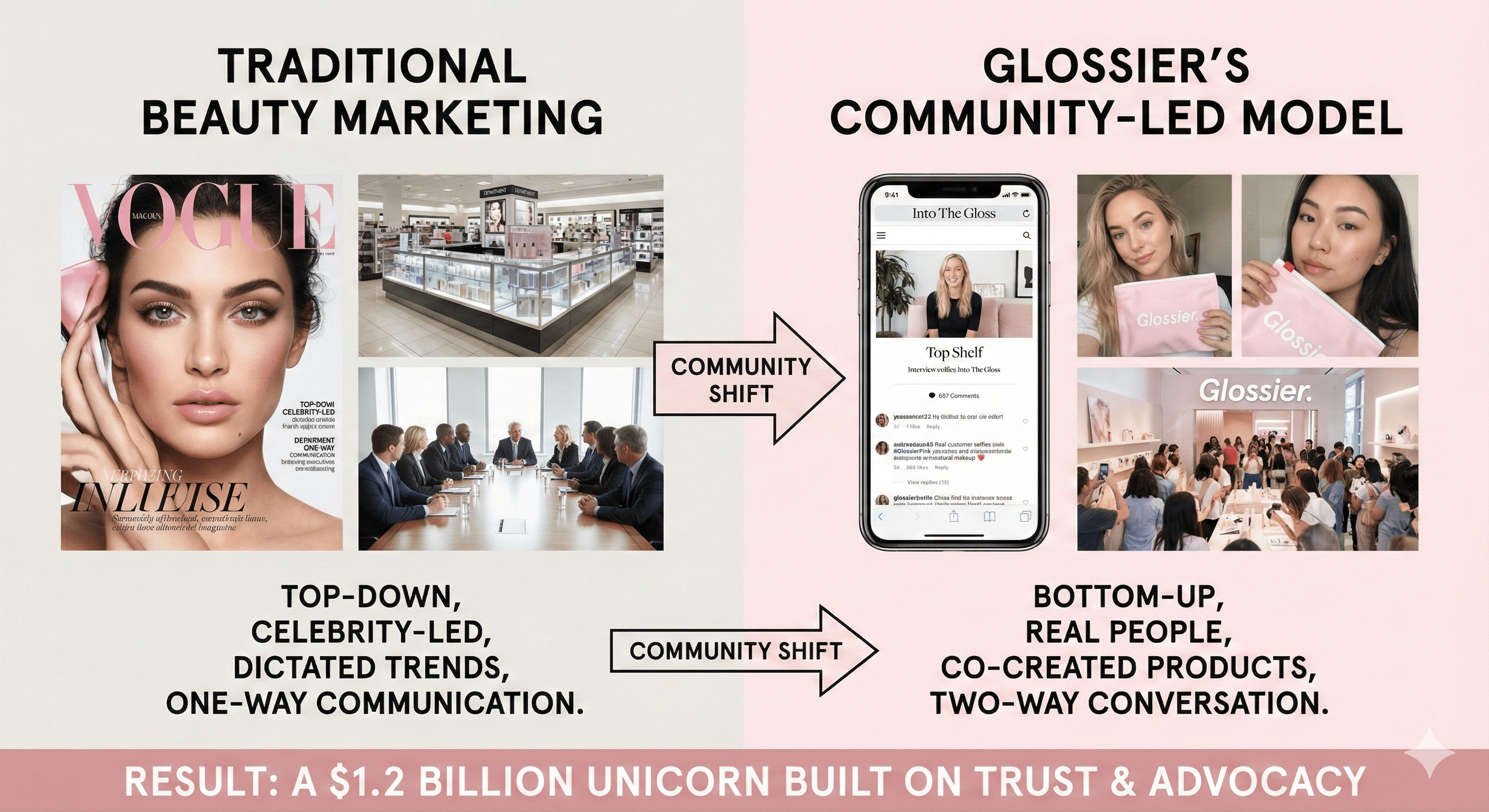
When Into The Gloss launched in 2010, the beauty industry was still dominated by legacy brands that marketed in a top-down way: glossy campaigns, celebrity spokespeople, heavily retouched images, and product lines decided in boardrooms and labs, then pushed to consumers via department stores and magazine ads. Consumers had limited ways to talk back, and “community” mostly meant focus groups and customer service hotlines.
At the same time, social media and blogs were giving beauty enthusiasts new spaces to share honest opinions, routines, and product hacks. Readers trusted each other—bloggers, friends, micro-creators—more than ad copy. Into The Gloss tapped this shift by:
- Publishing The Top Shelf interviews where real people shared their bathroom shelves and routines
- Asking readers questions in the comments and treating their responses as valuable input, not noise
- Creating a tone that felt like friends talking in a bathroom, not a brand lecturing about perfection
By the time Emily Weiss decided to launch Glossier in 2014, Into The Gloss had built a large, highly engaged audience and a deep pool of qualitative insight. The beauty market was crowded with products, but there was a gap: no major brand was truly built with consumers from the beginning, using digital community as its foundation.
The Specific Tactic: “Born From Content, Fueled By Community”
Glossier’s core tactic can be summarized in its oft-cited strategic line: “born from content; fueled by community.” Instead of treating content and community as marketing channels bolted on after product development, Glossier made them the starting point.
Key components of that tactic:
- Use Into The Gloss as a long-running research engine to identify unmet needs
- Launch products that directly answered community requests (e.g., Milky Jelly Cleanser, Boy Brow)
- Make customer photos and stories the primary content on Glossier’s own channels
- Turn social and UGC into the main acquisition and trust driver rather than classic advertising
Harvard Business School’s case on Glossier notes that sales grew 600% in 2017 and the customer base tripled, attributing the momentum largely to this community-led, digital-first approach.
The Insight: Customers Want To See Themselves In The Brand
Glossier’s strategy rests on several insights about consumer behavior and the beauty category:
- People Trust People More Than Brands
Into The Gloss showed that readers cared most about real routines and honest opinions, not slogans. They wanted to see how products actually looked on skin like theirs, in real bathrooms and natural light, not in heavily edited campaigns. - Community Can Be A Source Of Product-Market Fit
Instead of guessing what to make, Glossier treated comments, social posts, and DMs as an ongoing stream of market research. Questions like “What’s your dream cleanser?” or “What frustrates you about brow products?” became direct inputs for product briefs. - Minimalism and “Skin First” Were Underserved Desires
Through Into The Gloss, Weiss saw many people expressing fatigue with heavy, full-coverage makeup and complicated routines. They wanted products that enhanced natural skin, were easy to use, and felt like “everyday uniforms” rather than special-occasion armor. - Social Media Turns Packaging Into Media
Glossier realized that Instagram made packaging itself a kind of ad. If products looked good on bathroom shelves and in selfies—millennial pink pouches, minimalist tubes, clean typography—customers would photograph and share them organically.
These insights pushed Glossier to build around customer-led growth: let the community shape what exists, then let their advocacy and content power distribution.
The Execution: From Blog Comments To Cult Products
Glossier operationalized its insight and tactic across product, brand, and distribution.
From Into The Gloss To Product Roadmap
Weiss and her team paid close attention to recurring themes in blog comments, emails, and interviews:
- Complaints about cleansers that stripped skin or felt too harsh
- Frustration with brow products that were too stiff, too dark, or too dramatic
- Desire for products that gave a “your skin but better” effect
Examples of community-informed products include:
- Milky Jelly Cleanser – developed after asking Into The Gloss readers what their dream face wash would be. The team collected feedback on texture, scent, and after-feel, then formulated a gentle, non-foaming cleanser that matched those desires.
- Boy Brow – inspired by frustration with existing brow gels and pencils; Glossier created a brow pomade in a mascara-like tube, designed to subtly thicken and groom without looking overdone.
Community input did not stop at ideation. Glossier used surveys, social polls, and ongoing feedback loops to refine shades, packaging, and formulas.
Social Media As Community Hub, Not Billboard
Glossier’s social strategy centered on user-generated content and two-way conversation, especially on Instagram:
- The brand encouraged customers to share photos using hashtags like #GlossierPink and #GlossierIRL.
- Glossier regularly reposted customer photos on its official feed, making everyday users the face of the brand rather than only professional models.
- This created a virtuous cycle: being featured by Glossier felt like recognition, which incentivized more customers to create content.
Reports and case studies highlight that:
- Around 70% of Glossier’s online sales came from peer referrals, indicating heavy reliance on word-of-mouth and social proof.
- Up to 80% of customers were referred by friends, showing how deeply advocacy, rather than paid ads, drove acquisition.
Glossier’s Instagram aesthetic—soft lighting, diverse faces, minimal makeup—deliberately contrasted with traditional beauty campaigns, reinforcing its “skin first, makeup second” ethos.
Visual Identity As A Shareability Engine
Glossier’s physical branding and unboxing experience were designed to be inherently shareable:
- Millennial pink bubble-wrap pouches and stickers became instantly recognizable.
- Minimalist packaging and consistent color schemes created a cohesive “Glossier look” across bathrooms and vanities.
- Customers often posted “shelfies” showcasing Glossier products, effectively turning their homes into micro-billboards.
This approach turned every order into potential content. Visual identity was not just about consistency; it was a growth lever.
Owned Community Spaces And Direct Conversation
Beyond public social feeds, Glossier nurtured community in owned spaces:
- Private Facebook groups and online forums where fans could share routines, ask questions, and discuss products
- Email newsletters that felt like letters from a friend, not just promotional blasts
- A “gTeam” customer service function that responded to DMs and messages in a human, conversational tone
This made interactions feel personal and two-sided. Customers were not just buyers—they were participants in an ongoing conversation.
Offline Experiences That Felt Like Extensions Of The Feed
Glossier’s pop-up shops and permanent stores were designed as physical embodiments of the brand’s online aesthetic:
- Soft pinks, mirrors, and selfie-friendly corners encouraged visitors to take photos and tag the brand.
- Staff acted more like beauty friends than salespeople, focusing on helping visitors play with products.
- Stores functioned as community spaces, not just retail outlets, reinforcing emotional attachment.
These offline experiences created additional UGC and strengthened the connection between digital and physical touchpoints.
The Result: Rapid Growth And A New Playbook
Glossier’s community-led approach delivered impressive business results:
- Sales grew approximately 600% in 2017, with the customer base tripling that year, according to Harvard Business School case material.
- By 2019, Glossier reached a reported valuation of about $1.2 billion, officially becoming a “unicorn” in the beauty space.
- The brand built a cult-like following, with fans often describing themselves as part of the “Glossier girl” community and strongly identifying with the brand’s minimalist, inclusive ethos.
Even as Glossier later faced operational and retail challenges, it remained a widely cited example of how a digital-first, community-driven strategy can rapidly build brand equity and scale.
Why It Worked: The Transferable Principles
Several principles underpin Glossier’s success and can be adapted across industries.
Treat Community As Your R&D Lab
Glossier did not use community only for engagement after launch. It used community as a source of product-market fit before and during development.
Transferable principle: Build systems to capture and act on customer input continuously—comments, reviews, surveys, DMs—and fold that into product decisions. This reduces guesswork and increases the odds that launches resonate.
Make Customers The Main Characters
By featuring real customers in content and using their language, Glossier made people feel seen and valued. The brand’s feeds looked like an extension of its community, not a separate corporate voice.
Transferable principle: Shift from “brand-centric storytelling” to “customer-centric storytelling.” Use real stories, faces, and words whenever possible.
Design For Shareability From Day One
Glossier’s packaging, store design, and visual aesthetic were all created with social sharing in mind. Every element doubled as potential content.
Transferable principle: When designing products or experiences, ask: “Would someone want to take a photo of this and share it?” If yes, you’ve created a built-in distribution channel.
Prioritize Advocacy Before Advertising
Instead of leading with large paid campaigns, Glossier focused on word-of-mouth and peer-to-peer referrals. Paid media, when used, amplified what the community had already validated.
Transferable principle: Especially for early-stage brands, focus first on creating products and experiences so good—and so aligned with a community—that people naturally talk about them. Use paid only to accelerate what’s already working.
Build A Distinct, Human Voice
Glossier’s tone, from Into The Gloss through its brand channels, felt like a friend who knows a lot about beauty, not a corporate entity. That voice built trust and relatability.
Transferable principle: Develop a brand voice that sounds like a real person from your target community. Consistency and humanity often matter more than polish.
How Students Can Apply This
To turn Glossier’s story into practical learning:
- Exercise 1 – Community-First Product Brief:
Pick a category (skincare, fitness, SaaS). Imagine you run a blog or community in that space. Write a product brief using only inputs from “comments” and “DMs” (invented if needed). What patterns do you see? - Exercise 2 – UGC Engine Design:
Design a UGC strategy for a brand: which hashtags, repost rules, and recognition mechanisms would you use to encourage customers to create content? - Exercise 3 – Visual Identity Audit:
Choose a product and sketch (or describe) a packaging and unboxing experience that would make people want to post about it. Explain how each element reinforces the brand’s positioning.
The overarching marketing principle: When a brand is genuinely co-created with its community—using their voices, needs, and images as the foundation—growth can be driven more by advocacy than by ad spend.
Sources
- Agility PR Solutions. (2025, May 12). 5 ways digital PR transformed Glossier into a global beauty brand. Agility PR. https://www.agilitypr.com/pr-news/content-media-relations/5-ways-digital-pr-transformed-glossier-into-a-global-beauty-brand/
- Extole. (2025, September 16). Glossier marketing and the value of customer-led growth. Extole. https://www.extole.com/blog/glossier-marketing-how-the-beauty-brand-used-word-of-mouth-to-shake-up-the-industry/
- Graduate Community (Gradual). (2025, November 6). Glossier’s community-led brand: Advocacy before advertising. Gradual. https://community.gradual.com/public/resources/glossiers-community-led-brand-advocacy-before-advertising
- Harvard Business School. (2025, December 3). Glossier: Co-creating a cult brand with a digital community [Case study]. Harvard Business School. https://www.hbs.edu/faculty/Pages/item.aspx?num=54905
- Into The Gloss. (2014, October 20). Introducing Glossier. Into The Gloss. https://intothegloss.com/2014/10/emily-weiss-glossier/
- OptiMonk. (2024, July 8). Glossier marketing breakdown: How this beauty brand became a cult favorite. OptiMonk. https://www.optimonk.com/glossier-marketing-breakdown/
- Pennep. (2025, July 17). How Glossier built a cult following through Instagram and user-generated content. Pennep. https://www.pennep.com/blogs/how-glossier-built-a-cult-following-through-instagram-and-user-generated-content
- Radarr. (2024, February 14). Glossier’s social media marketing strategy. Radarr. https://www.radarr.com/blog/glossier-social-media-marketing-strategy-breakdown/
- Scott Social Marketing. (2025, December 31). From blog to billion: Inside the Glossier marketing strategy. Scott Social Marketing. https://www.scottsocialmarketing.com/blog/from-blog-to-billion-inside-the-glossier-marketing-strategy
- Tetr. (2025, September 8). The Glossier effect: How a beauty blog transformed into a billion-dollar brand. Tetr. https://tetr.com/blog/the-glossier-effect-how-a-beauty-blog-transformed-into-a-billion-dollar-brand
- The Influence Agency. (2025, July 8). How community management built brands: Glossier, Peloton, Duolingo. The Influence Agency. https://theinfluenceagency.com/blog/community-management-glossier-peloton-duolingo/



.png)