January 16, 2026
Welcome To Waufl Academy – Your Shortcut To Real-World Marketing Mastery
This isn’t a theory textbook—every lesson here comes from campaigns that actually made money.

They used a Halloween burrito deal to crash Roblox and hit record digital sales.


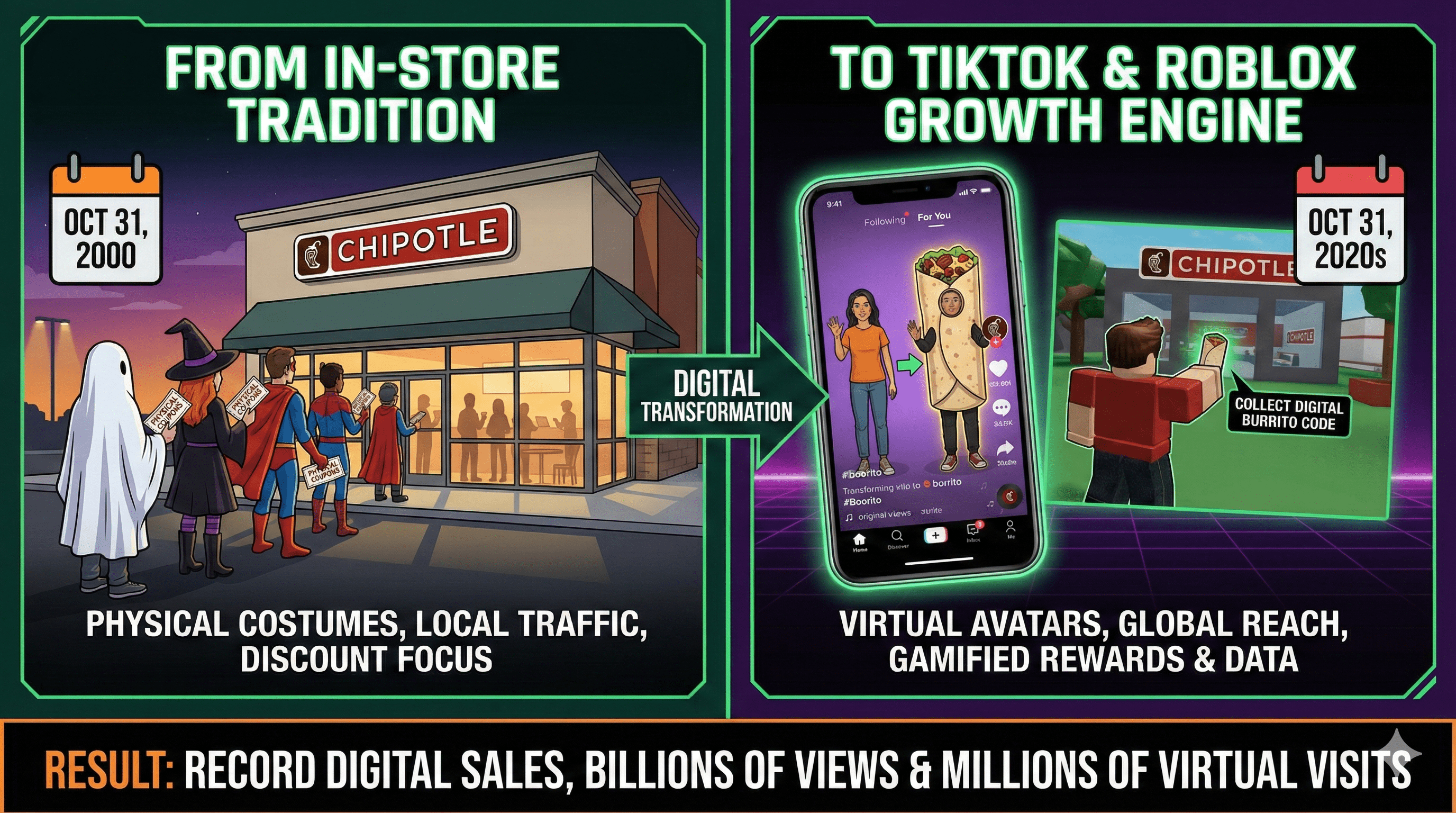
Chipotle took a long-running in-store Halloween promotion, “Boorito,” and turned it into a digital growth machine by moving it onto TikTok and Roblox. Instead of just offering discounted burritos to people who showed up in costume, the brand invited fans to create TikTok videos, explore a virtual Chipotle restaurant in the metaverse, and unlock free burritos through digital codes. This shift not only kept the tradition alive during the pandemic and beyond, but it also drove billions of views, millions of virtual visits, new rewards sign-ups, and record digital sales—all without relying on traditional TV-heavy campaigns.
Chipotle launched its “Boorito” promotion in 2000 as an in-restaurant Halloween event: customers who came dressed in costume could get discounted burritos. Over two decades, it became an annual tradition and a distinctive brand ritual. The promotion drove in-store traffic and created a sense of community around the brand each Halloween.
By 2019–2021, several forces pushed Chipotle to rethink how Boorito worked:
The company had already been investing in digital ordering, with digital sales making up roughly 43% of total sales in Q3 2021. Boorito needed to evolve from an in-store costume party into an experience that could:
Chipotle’s marketing team saw an opportunity: turn Boorito into a multi-platform digital activation that blended user-generated content, gaming, and rewards.
The core tactic was to rebuild Boorito as a digital-first, gamified promotion centered on:
Instead of “come to the restaurant in costume,” the new Boorito asked fans to:
This reframed Boorito from a one-location, one-night event into a distributed digital experience that could scale across millions of participants.
Chipotle’s shift was grounded in several insights about consumer behavior:
Chipotle’s execution played out in several key components.
Chipotle brought Boorito to TikTok by launching the #Boorito challenge. The mechanics:
The results were huge by early TikTok brand standards: the #Boorito campaign amassed nearly 4 billion views within about four months, at a time when many brands were still skeptical about TikTok as a serious marketing platform. Event sales were reported up around 15% compared to prior Boorito periods, indicating that the creative social activation also drove tangible business.
This piece of the campaign shows the power of UGC and creator partnership: Chipotle did not need to produce every video. It set a clear prompt and let users and a prominent creator carry the content.
In 2020, when in-store events were limited by the pandemic, Chipotle moved Boorito entirely online:
This move preserved the sense of “Boorito” as a special event while adapting to public health constraints and strengthening digital ordering.
In 2021, Chipotle took Boorito into the metaverse by launching a virtual restaurant and Boorito Maze on Roblox:
The metrics were significant:
Chipotle also innovated on the Roblox platform by working with developers and Roblox’s product team to integrate unique, redeemable codes into the experience for the first time, creating a new type of bridge between virtual and real-world value.
Across these campaigns, Chipotle made a consistent choice: Boorito perks would primarily be unlocked and redeemed digitally:
This stitched the Halloween fun into the brand’s long-term digital growth strategy.
Boorito’s evolution delivered both awareness and performance outcomes:
For marketing students, this case shows how a legacy promotion can be turned into a platform for experimentation in social, gaming, and loyalty.
Several core principles make the modern Boorito strategy a useful template.
Boorito is not just a discount; it is a ritual—costumes, content, and now virtual quests. The TikTok challenge and Roblox maze turned customers into co-creators, not passive recipients of a coupon.
Transferable principle: Design promotions as activities people do (challenges, quests, creation prompts), not just prices they see. This generates UGC, social proof, and emotional connection.
By moving into TikTok and Roblox, Chipotle met younger consumers in their native environments. Instead of trying to drag them to a branded microsite, the brand built experiences inside platforms they loved.
Transferable principle: Identify the digital spaces your target audience already inhabits (TikTok, Twitch, Discord, Roblox, etc.) and build brand experiences there, rather than forcing them into unfamiliar environments.
Chipotle did not stop at views and visits. Free burrito codes and digital-only deals:
Transferable principle: Always ask, “How does this fun experience move people deeper into our ecosystem?” Even playful campaigns should have a clear path to data, trial, or repeat behavior.
Boorito was a known ritual with built-in equity. Chipotle did not invent a new campaign from scratch; it reimagined Boorito for new platforms and contexts.
Transferable principle: Look for existing events, holidays, or brand traditions that can be “digitally remixed.” It is often easier to evolve a familiar ritual than to convince people to care about a brand-new campaign.
Chipotle’s early, bold bets on TikTok and Roblox positioned the brand as a leader. When competitors were still skeptical, Chipotle was already learning how to drive results on those platforms.
Transferable principle: Allocate a portion of your budget and creativity to experimentation on emerging platforms. Being first (and good) can deliver outsized returns and press coverage.
To turn Chipotle’s Boorito evolution into practical exercises:
The overarching principle: The most effective modern promotions turn brand traditions into interactive, digital-native experiences that entertain, capture data, and drive measurable behavior change.
.png)