January 16, 2026
Welcome To Waufl Academy – Your Shortcut To Real-World Marketing Mastery
This isn’t a theory textbook—every lesson here comes from campaigns that actually made money.

They made a language app go viral by letting the mascot act like a chaotic creator.


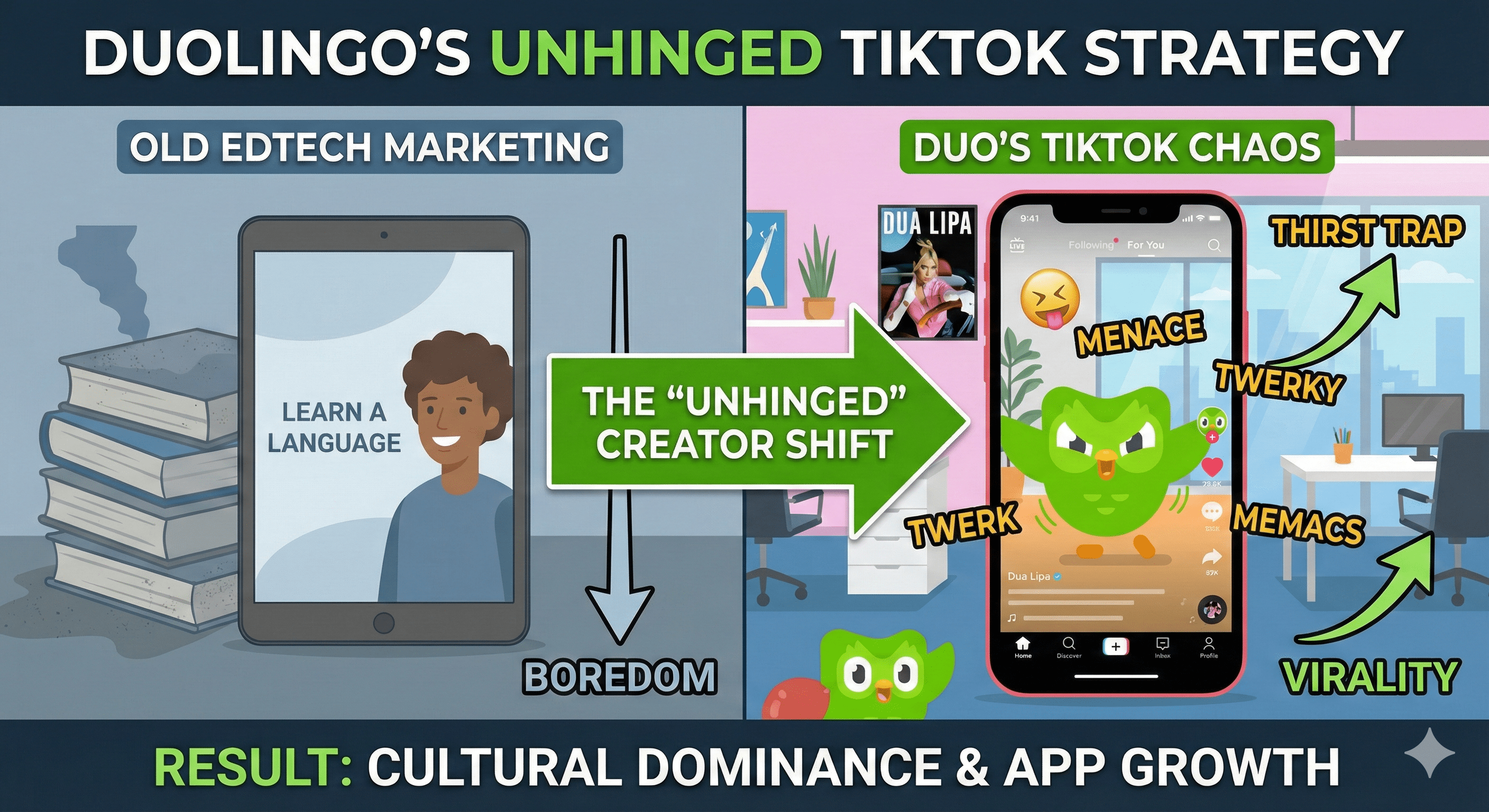
Duolingo turned what could have been a dry education product into one of the most followed and discussed brands on TikTok by letting its green owl mascot behave less like a corporate logo and more like an unhinged creator. Rather than posting grammar tips or polished brand content, the company leaned into memes, trends, and self-aware chaos, often featuring Duo the Owl twerking in the office, pining over celebrities, or “threatening” users who skip lessons. This strategy did more than generate laughs: it drove follower growth into the millions, boosted app installs, and helped Duolingo reinforce its position as the top language-learning app globally.
By the early 2020s, Duolingo was already a successful language-learning app, but it played in a crowded and increasingly expensive digital advertising environment. Customer acquisition costs were rising across social platforms, and traditional performance marketing was becoming less efficient. At the same time, TikTok was emerging as a dominant platform for Gen Z and younger millennials, with users spending close to an hour per day on the app.
EdTech brands traditionally used social media for safe, utility-driven content: lesson snippets, explainer videos, user testimonials, and static graphics. This approach blended into the background of feeds filled with humor, drama, and entertainment. Educational apps risked being perceived as chores rather than culture. Duolingo needed a way to cut through an environment where every scroll offered dopamine from creators, not brands.
The brand’s internal data also showed a dynamic often joked about online: people would start a language, fall off the habit, and then get “guilt notifications” from the app. The internet had turned this into a meme—Duo the Owl was portrayed as a menacing presence reminding you to practice. Duolingo realized that instead of running from this meme, it could lean into it.
The central tactic was to recast Duo the Owl as a fully-fledged TikTok character and creator, not just a visual asset. This meant:
Duolingo’s TikTok content formula can be summarized as: Duo + trends + unhinged humor = engagement. Instead of asking, “How do we explain our features?”, the team asked, “What would be funny and on-trend for Duo to do today?” The app appears in the background as context, but the character and narrative come first.
The key insight was that TikTok users gravitate toward content that feels native, imperfect, and emotionally charged, and they distrust anything that feels like a conventional ad. Duolingo observed that high-performing TikToks are usually:
Duolingo also recognized the power of existing internet memes about their own brand. The joke that Duo “stalks” users and threatens them if they miss lessons was already widely known. Instead of denying or ignoring it, Duolingo leaned into that narrative, turning a potential negative (guilt) into a shared inside joke. This approach signals that the brand sees and understands its community.
Another insight: on TikTok, engagement and cultural relevance can drive top-of-funnel awareness more efficiently than traditional ads, especially for Gen Z. Duolingo’s marketing team noted that when TikTok content went viral, the “How did you hear about us?” survey inside the app showed measurable spikes in users who selected social media—especially TikTok—as their source.
Duolingo’s execution can be broken down into several deliberate moves.
Duolingo relaunched its TikTok presence around late 2021. Before that, the account had around 50,000 followers and featured more straightforward educational content. Once the new strategy—centered on Duo’s “unhinged” persona—was implemented, growth accelerated dramatically.
Within a few months, follower count multiplied dozens of times. Case studies report that the account grew roughly 40x in under five months from its relaunch baseline, eventually surpassing several iconic brands like Disney and Nike in follower count on TikTok. Eventually, Duolingo’s TikTok audience climbed into the multimillions, with some reports noting milestones like 6.6 million followers and then surpassing 10 million as the strategy matured.
The content itself is what makes the strategy distinctive:
One early breakout video showed the Duo mascot looming over a worker’s shoulder, with an onscreen caption like “when you’re just tryna do your work without being terrorized by an owl.” It directly referenced the running joke about Duo’s push notifications. That video amassed millions of views and hundreds of thousands of likes, proving that leaning into the meme resonated.
Importantly, Duolingo’s social team did not overly sanitize or overexplain these posts. They trusted that TikTok users understood the context and humor and allowed the content to feel like a creator’s feed rather than corporate marketing.
A crucial part of execution was organizational: Duolingo empowered a small Gen Z-led social team to act quickly, with autonomy. Zaria Parvez, the social media manager behind Duo’s persona, and colleagues like the person wearing the owl suit, became internal influencers—driving:
This structure is very different from brands that route every tweet or TikTok through multiple rounds of approvals. The speed and authenticity of Duolingo’s content come from this lean, empowered setup.
Even though many videos look like pure chaos, Duolingo subtly ties them back to its core product and brand:
A TikTok campaign case study from the platform itself described a back-to-school campaign that reached tens of millions of unique users, delivered tens of millions of video views, and saw click-through rates around 39% above education benchmarks, while growing the follower base more than 1,400% during the period. This demonstrates that “funny chaos” can co-exist with performance goals like installs and registrations.
While TikTok is the epicenter, Duolingo extends the character and tone across other platforms:
This multiplies the effect: a stunt or viral TikTok can become a meme on Twitter, a Reel on Instagram, and a story in marketing and business publications, creating a flywheel of attention.
The outcome for Duolingo spans both social and business metrics.
On the social side:
On the business side:
For students, the Duolingo case illustrates that “brand memes” are not just vanity metrics—they can drive real acquisition and reactivation.
Several marketing principles make Duolingo’s approach more than a one-off stunt.
Duo is not simply a static mascot; he is written and managed like a character with motivations, flaws, and a sense of humor. This gives the social team a narrative engine: they can drop Duo into any trend and ask, “How would this character react?”
Transferable principle: For many brands, it is easier to create ongoing content if you think in terms of a character or persona, not just a set of brand guidelines. This character can be a mascot, a founder, or even a fictional avatar that embodies your brand values.
Duolingo did not try to port TV ads to TikTok. It studied what works natively on TikTok—trends, sounds, chaotic humor—and adapted. High-performing posts look indistinguishable from creator content except for the presence of the owl.
Transferable principle: Each platform has its own culture and content language. Treat platforms like distinct countries with different norms. Study native behavior and design content that belongs there, rather than forcing cross-channel repurposing.
Instead of ignoring jokes about Duo being “threatening,” Duolingo exaggerated them. It turned a potentially negative meme into a shared inside joke with users, showing self-awareness and humility.
Transferable principle: If your brand is already being talked about in memes or jokes, consider how to safely embrace and redirect that energy instead of fighting it. Co-opting the narrative can build affinity.
The reason Duolingo can jump on trends quickly is that it empowered a small team of experts to act. Layers of approvals would kill the relevance and spontaneity that make the content work.
Transferable principle: If you want to win on fast-moving platforms, design your internal process around speed and trust. Define clear red lines (what is off-limits), then give your social team autonomy within those boundaries.
Duolingo shows that entertainment and performance marketing are not mutually exclusive. TikTok creates awareness and cultural love; the app itself and product design convert that into usage and revenue.
Transferable principle: Think of entertaining, brand-building content as the top of the funnel. Have mechanisms (like in-app “How did you hear about us?” surveys, custom landing pages, or codes) to attribute and learn from that attention.
To operationalize the Duolingo case in your own work:
The overarching marketing principle from Duolingo is: In an attention-scarce world, brands that behave like creators—fast, self-aware, and entertaining—can turn social media into a real growth engine, especially when they lean into existing culture instead of fighting it.
.png)