Motorwerks BMW of Barrington
Sets up the strategic challenge of luxury automotive retail commoditization and how the Anne Fontaine partnership solved it

Sets up the strategic challenge of luxury automotive retail commoditization and how the Anne Fontaine partnership solved it
Discover more visuals from our work a curated gallery of additional images showcasing details, variations, and creative process shots. Explore the depth and versatility behind each project.
Sets up the strategic challenge of luxury automotive retail commoditization and how the Anne Fontaine partnership solved it
In the luxury automotive retail landscape, where product information is commoditized and purchase decisions are increasingly driven by brand perception rather than specifications, Motorwerks BMW of Barrington—an M-Certified dealership serving Chicago's affluent North Shore—faced a fundamental strategic challenge: how to differentiate in a market where every competitor has access to identical inventory, comparable pricing, and standardized manufacturer marketing support.
The traditional automotive retail playbook—promoting monthly specials, highlighting financing incentives, showcasing inventory—creates a race to the bottom where luxury becomes indistinguishable from commodity. For a dealership serving Barrington's high-net-worth community, this approach represented an existential threat: when all marketing looks the same, the brand with the lowest price wins, eroding margins and attracting price-sensitive customers rather than lifestyle-aligned buyers who value experience over transaction.
Motorwerks BMW recognized that in luxury markets, the product is never just the product—it's the identity association, the community membership, and the lifestyle validation that comes with ownership. This insight drove a strategic partnership with Anne Fontaine, the iconic Parisian fashion house synonymous with understated elegance and sophisticated minimalism. The collaboration wasn't a promotional event—it was strategic brand positioning: demonstrating that Motorwerks BMW exists at the intersection of automotive performance and cultural sophistication.
Waufl Media was commissioned to transform this partnership into a digital asset that would extend far beyond the physical event, creating content that communicated brand values rather than product features, reached new high-net-worth prospects beyond the existing customer database, and established Motorwerks BMW as a cultural destination rather than a transactional retail environment.
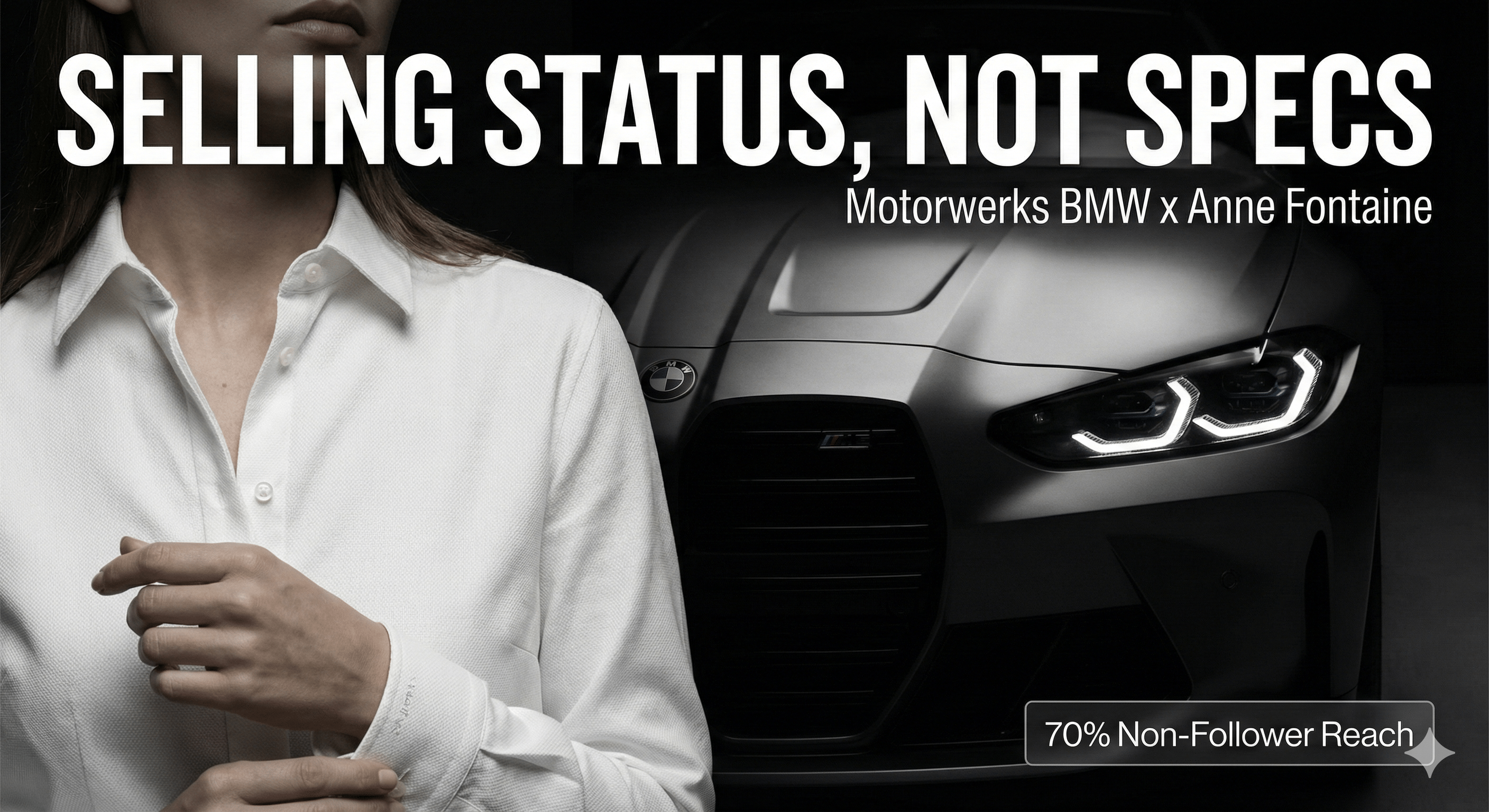
The resulting cinematic brand film achieved 70.1% reach among non-followers—successfully penetrating new audience segments who had never engaged with the dealership's content—while generating 4,138 views and 148 interactions that signaled high-value audience resonance. More significantly, the content created a replicable strategic framework: positioning the dealership not as a place to buy cars, but as the epicenter of the Barrington luxury lifestyle where automotive excellence, fashion sophistication, and community culture converge.
This case study demonstrates how luxury automotive retailers can leverage enterprise brand strategy—typically reserved for global OEMs like Mercedes-Benz and Porsche—at the dealership level, creating differentiation that commands premium pricing and attracts ideal customer profiles who value experience over discounting.
Motorwerks BMW of Barrington operates within a uniquely competitive market structure. As part of the prestigious Murgado Automotive Group and one of the few BMW M-Certified Centers in the Chicago metropolitan region, the dealership maintains operational standards and service capabilities that exceed typical BMW franchise requirements. M-Certification requires specialized technician training, dedicated performance facilities, and demonstrated expertise in BMW's highest-performance vehicle portfolio—positioning Motorwerks as the destination for serious automotive enthusiasts seeking track-capable machines and precision engineering.
However, operational excellence and technical certification—while necessary—are insufficient differentiators in 2026's luxury automotive retail environment. The market has fundamentally shifted from information asymmetry to perception competition.
Twenty years ago, car dealerships controlled information flow. Customers relied on salespeople for specifications, pricing, and availability. Today, every detail is accessible before a prospect ever contacts a dealership:
Complete Price Transparency: Third-party aggregators (TrueCar, Edmunds, Cars.com) provide invoice pricing, market averages, and negotiation guidance. The information advantage that once justified dealership margins has evaporated.
Specification Democratization: Manufacturer websites, automotive journalism, and YouTube reviewers provide exhaustive technical details, comparison testing, and ownership experiences. Customers arrive at dealerships more informed than most salespeople.
Review Ecosystem Ubiquity: Google reviews, dealer-specific rating sites, and social media conversations create public accountability that forces service quality convergence. Every dealership must maintain minimum standards or face algorithmic punishment in local search.
Digital Inventory Access: Real-time inventory visibility across entire metropolitan areas allows customers to comparison-shop inventory without physical visits. Geographic convenience—once a sustainable advantage—no longer protects market share.
This information commoditization creates a dangerous dynamic: when customers perceive products as identical and have complete pricing transparency, the only remaining competitive variable is price. This race-to-the-bottom destroys margins, attracts price-sensitive customers who generate minimal lifetime value, and erodes brand positioning built over decades.
Barrington, Illinois, represents one of Chicago's most affluent suburban markets. Median household income significantly exceeds national averages, educational attainment skews heavily toward advanced degrees, and the community exhibits sophisticated consumption patterns that prioritize quality, exclusivity, and experience over cost optimization.
This demographic doesn't respond to traditional automotive advertising. They're not motivated by "$299/month lease offers" or "Summer Sales Events." They view automotive purchases as lifestyle statements—extensions of personal identity and social positioning. For this audience, where they buy matters as much as what they buy, because the dealership experience itself communicates status and taste.
Competitors in the market—other luxury franchises serving similar demographics—increasingly recognize this reality. Audi, Mercedes-Benz, Lexus, and Porsche dealerships in the North Shore corridor invest heavily in experiential marketing, showroom design, and community engagement to differentiate beyond product. The competitive question isn't "who has the best cars?" but "who best represents the lifestyle our customers aspire to?"
Motorwerks BMW's challenge was clear: in a market where product is commoditized and information is ubiquitous, how do you create meaningful differentiation that attracts ideal customers, commands premium pricing, and generates advocacy that compounds over time?
The answer: become the cultural hub where the target demographic already lives, rather than a transactional environment they visit only when forced by automotive need.
Before the Anne Fontaine partnership, Motorwerks BMW maintained standard automotive retail marketing: inventory highlights, promotional messaging, service reminders, and occasional event announcements. This content—functionally competent but strategically generic—created three critical limitations:
Luxury consumers are extraordinarily sensitive to aesthetic inconsistency. They evaluate brands through a holistic lens where every touchpoint must reinforce positioning. A Mercedes-Benz customer expects showroom design, website aesthetics, service communication, and social media content to all signal the same values: sophistication, attention to detail, premium quality.
Motorwerks BMW's previous content, while professional, utilized conventional automotive videography: static shots of vehicles, specification overlays, promotional text graphics. This aesthetic—common across the entire automotive retail category—failed to differentiate. When your content looks like every other BMW dealership's content, you're competing on product and price rather than brand perception.
The Anne Fontaine partnership presented enormous opportunity—and enormous risk. Anne Fontaine represents Parisian elegance, architectural minimalism, and sophisticated femininity. Their brand aesthetic is instantly recognizable: clean lines, monochromatic palettes, emphasis on texture and craftsmanship over flash and trend.
If Motorwerks BMW documented this partnership with standard automotive event coverage—handheld footage, basic edits, product-focused framing—the content would have signaled profound brand misalignment. It would have told Anne Fontaine that Motorwerks didn't understand luxury brand language, and told the target audience that the dealership was merely hosting an event rather than embodying the values that event represented.
The aesthetic challenge: create content sophisticated enough to match Anne Fontaine's brand standards while still communicating automotive performance and capability—essentially, merge fashion film aesthetics with automotive commercial production values.
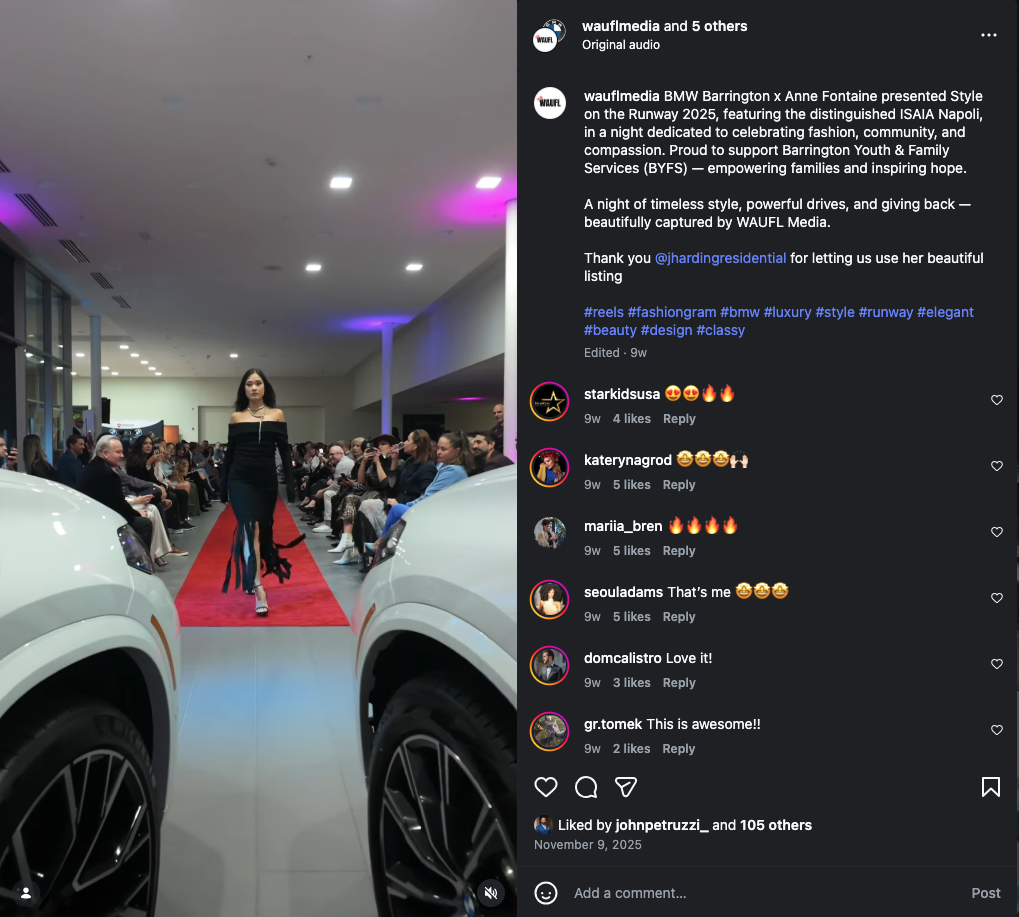
High-end experiential marketing events represent significant investment: venue costs, partner coordination, catering, staffing, invitation management. For the Anne Fontaine collaboration, the evening delivered immense value to the 150-200 attendees who experienced the showroom transformed into a Parisian boutique, with fashion models moving between Anne Fontaine collections and BMW M-Series vehicles.
However, without strategic content production, that value evaporates the moment the last guest leaves. The ROI of the event becomes limited to:
This represents a 200-person impact maximum—a valuable outcome, but constrained by physical attendance limitations.
The strategic opportunity: create a digital asset that extends the event's reach exponentially, allowing the brand positioning, aesthetic sophistication, and lifestyle alignment demonstrated during the event to reach thousands of high-net-worth prospects who couldn't attend, preserving the evening's atmosphere in a format that generates value indefinitely.
The content challenge: capture not just what happened, but how it felt—the ambient sophistication, the social validation of attendance, the seamless integration of automotive and fashion luxury that can only be experienced at Motorwerks BMW.
Like most established businesses with loyal customer bases, Motorwerks BMW's social media suffered from audience concentration: the same followers engaging with every post, minimal reach beyond the existing database, algorithmic stagnation that prevented content from penetrating new prospect segments.
This echo chamber dynamic is particularly problematic in automotive retail. Existing customers—while valuable for service revenue—have limited near-term vehicle purchase probability. Someone who bought a BMW 12 months ago won't be in-market for 3-4 years. Marketing that only reaches existing customers generates minimal sales pipeline.
The strategic imperative: create content compelling enough to break algorithmic barriers, reaching high-net-worth prospects in the Barrington market who have never engaged with Motorwerks BMW's content. These are households earning $200K+, currently driving luxury vehicles, potentially considering BMW for their next purchase—if they were aware of the dealership's unique positioning.
The distribution challenge: produce content that social algorithms recognize as high-value (generating saves, shares, extended watch time) so they distribute it beyond the existing follower base into the feeds of ideal prospects who match target demographic profiles.
These three problems—aesthetic misalignment risk, event ROI dissipation, and echo chamber distribution—converged into a single strategic question: how do we transform a one-night partnership event into a permanent brand asset that reaches new audiences and communicates luxury positioning at the level our target demographic expects?
Waufl Media's approach to the Motorwerks BMW x Anne Fontaine partnership was informed by a strategic framework deployed by global luxury conglomerates—specifically, LVMH (Moët Hennessy Louis Vuitton) and Mercedes-Benz's brand architecture strategy—where products are positioned not through features and benefits, but through cultural association and lifestyle integration.
This framework, which we term "Brand Convergence," operates on a fundamental luxury marketing principle: high-net-worth consumers don't buy products; they buy identity reinforcement and social positioning.
LVMH—the world's largest luxury conglomerate, encompassing brands from Louis Vuitton to Dom Pérignon to TAG Heuer—pioneered cross-brand collaboration as strategic positioning tool. When Louis Vuitton partners with Supreme, or when Dior collaborates with Jordan Brand, these aren't revenue-driven product launches—they're strategic signals that reposition brands in cultural conversation.
The strategic logic:
Association Transfers Equity: When two prestigious brands collaborate, their respective audiences gain exposure to complementary luxury expressions. BMW enthusiasts discover Anne Fontaine; fashion-forward women discover BMW's design sophistication.
Cultural Relevance Amplification: Luxury brands must constantly demonstrate cultural relevance to avoid perception as "heritage" (euphemism for outdated). Unexpected collaborations signal creative vitality and contemporary thinking.
Content Multiplication: A single event creates multiple content angles—the fashion perspective, the automotive perspective, the lifestyle integration—each reaching different audience segments.
Social Proof Through Exclusivity: Collaborations that feel selective and intentional (not desperate promotional partnerships) communicate brand confidence and desirability.
Motorwerks BMW's partnership with Anne Fontaine followed identical strategic logic. This wasn't "we need to sell more cars" thinking—it was "we need to position BMW ownership as part of a sophisticated, culturally engaged lifestyle" strategy.
Mercedes-Benz Global pioneered automotive lifestyle marketing in the early 2000s with their "The Best or Nothing" campaign architecture, which systematically avoided product features in favor of lifestyle association.
Their content strategy: position Mercedes-Benz vehicles as silent witnesses to sophisticated living rather than products to be sold. Campaigns featured art gallery openings, yacht club gatherings, architectural tours—environments where Mercedes-Benz was present but not promoted, suggesting that ownership was a natural consequence of refined taste rather than a purchasing decision to be justified.
This approach recognized a fundamental truth about luxury automotive psychology: people who can afford $80,000+ vehicles don't need persuasion on specifications—they need social permission and identity validation.
Waufl Media applied this blueprint to the Motorwerks BMW project. The content wasn't designed to "sell" BMW features. It was designed to demonstrate that BMW ownership is what sophisticated people in Barrington do—it's the natural automotive expression of someone who appreciates Parisian fashion, architectural design, and cultural engagement.
Pillar 1: Aesthetic Parity Over Product Promotion
The content production mandate was uncompromising: the visual quality must match what Anne Fontaine would expect for their own brand content. This meant:
Cinematic Production Values: Film-style shallow depth-of-field, intentional lighting design, color grading that emphasized texture and contrast. Every frame must be independently beautiful—worthy of fashion editorial publication.
Architectural Framing: Compositional choices that emphasized symmetry, leading lines, and negative space—mirroring both BMW's design philosophy and Anne Fontaine's minimalist aesthetic.
Texture Emphasis: Visual focus on material quality—the grain of leather in BMW interiors juxtaposed with the weave of Anne Fontaine textiles, the chrome details of BMW engineering meeting the metallic accents in fashion accessories.
Human Movement as Narrative: Models and guests moving through space, creating visual flow and energy. The content needed to feel alive and experiential rather than static and promotional.
This aesthetic approach served strategic purpose: it signaled to both Anne Fontaine and the target audience that Motorwerks BMW operates at the highest standard of brand sophistication. Mediocre content would have undermined the entire partnership premise.
Pillar 2: FOMO (Fear of Missing Out) as Conversion Mechanism
Luxury marketing's most powerful tool isn't persuasion—it's exclusivity. The strategic goal wasn't convincing people BMW is good (everyone already knows this); it was making people feel they're missing out on something special by not being part of the Motorwerks BMW community.
The content narrative was architected to create urgency and desire:
Guest Interaction Emphasis: Footage of VIP attendees networking, laughing, engaging with both fashion and vehicles. This communicated: "Important people gather here; you should be among them."
Atmospheric Details: Champagne glasses, architectural showroom lighting, carefully styled product displays. These details suggested sophistication and care that can only be experienced at this location.
Model Integration: Fashion models moving between Anne Fontaine collections and BMW vehicles, creating visual metaphor—both are expressions of the same refined aesthetic sensibility.
Temporal Specificity: The content emphasized "This happened here, and if you weren't there, you missed something special." This scarcity drives future attendance at Motorwerks events and positions the dealership as a cultural destination worth monitoring.
The FOMO mechanism shifts audience psychology from passive observer to active participant-in-waiting. They're not watching a commercial; they're previewing a community they want to join.
Pillar 3: Algorithm-First Distribution Strategy
Creating sophisticated content means nothing if it doesn't reach target audiences. The distribution strategy was engineered for Instagram's algorithm specifically, recognizing that the platform heavily prioritizes content that generates:
Extended Watch Time: The video needed to capture attention immediately and maintain it, signaling to Instagram that this is high-quality content worthy of broader distribution.
Engagement Velocity: Quick accumulation of likes, comments, saves, and shares in the first 60 minutes post-publication triggers algorithmic amplification.
Share and Save Rates: Instagram treats saves and shares as stronger quality signals than likes (anyone can like; saving/sharing indicates genuine value perception).
The Hook Strategy: The opening 3 seconds featured the most visually striking imagery—fashion models, atmospheric lighting, movement—specifically designed to bypass the mental "skip" reflex people have developed for automotive advertising. By leading with fashion and lifestyle rather than cars, the content avoided immediate categorization as "dealership promotion," allowing it to be consumed as aspirational lifestyle content.
This strategic framing—fashion-first, automotive-second—allowed the content to reach audiences who wouldn't normally engage with car dealership posts. By the time they realized they were watching BMW content, they were already emotionally invested in the aesthetic experience.
Strategic frameworks require flawless execution to generate results. The Motorwerks BMW x Anne Fontaine project demanded production capabilities and operational discipline that separated enterprise agencies from standard videographers.
Timeline Intensity: Unlike controlled commercial shoots with multiple days and staged scenarios, this was live event documentation with one opportunity to capture content. The 3-hour event window required simultaneous multi-angle coverage, real-time shot selection, and adaptive repositioning as the evening unfolded.
Invisible Operation: VIP guests attended for the experience, not to be filmed. The production team operated with minimal intrusion—no bright lights disrupting conversations, no crew blocking guest movement, no obvious "you're being filmed" atmosphere that would have made attendees self-conscious and destroyed authentic moments.
Brand Protection for Two Entities: Every shot, angle, and edit decision had to serve both brands simultaneously. Overemphasizing BMW would alienate Anne Fontaine; overemphasizing fashion would fail to leverage the automotive investment. The balance required constant real-time evaluation.
Technical Excellence Under Pressure: No retakes, no do-overs. Every shot captured had to be technically perfect—proper exposure, focus, composition—because there wouldn't be another opportunity.
Camera Strategy: Multiple cinema cameras with prime lenses (fixed focal lengths) rather than zoom lenses. Prime lenses provide superior optical quality and the shallow depth-of-field that creates "cinematic" separation between subject and background—the visual signature of premium content.
Lighting Philosophy: Minimal artificial lighting, instead leveraging and enhancing the showroom's architectural lighting design. Additional lighting was strategically placed to highlight texture (fabric weave, leather grain, vehicle surfaces) without creating obvious "video production" atmosphere.
Movement and Stabilization: Gimbal-stabilized camera movement allowed fluid tracking shots following models and guests through space. This created visual dynamism while maintaining the smooth, controlled aesthetic associated with luxury content.
Audio Capture: High-quality ambient sound recording—champagne glasses, conversation murmur, footsteps on showroom floor—to be layered into the final edit. Luxury content requires sophisticated audio design; cheap content sounds cheap regardless of visual quality.
The editing process transformed raw footage into strategic narrative through multiple deliberate choices:
Pacing and Rhythm: The edit maintained energy without feeling rushed—balancing lingering shots that allowed appreciation of details (fashion texture, vehicle lines) with dynamic transitions that maintained engagement. Luxury pacing is deliberate, never frenetic.
Color Grading: Sophisticated color correction that emphasized the monochromatic Anne Fontaine aesthetic (blacks, whites, subtle grays) while preserving BMW's signature color palette. The grade created visual cohesion that tied fashion and automotive elements together.
Audio Design: Layered soundscape combining ambient event audio, subtle music bed, and strategic silence. The audio created emotional texture—moments of intimate conversation contrasted with energetic crowd atmosphere.
Strategic Product Integration: BMW vehicles appeared throughout but were never explicitly promoted. They were environmental elements—beautiful objects in a beautiful space—suggesting naturalness and inevitability rather than sales pitch.
Human Connection Focus: The edit prioritized authentic human moments—laughter, conversation, appreciation of beauty—over product close-ups. Luxury consumers respond to social validation and community belonging, not specifications.
The final video was edited, graded, and delivered within 48 hours of event conclusion. This rapid turnaround was strategically critical:
Social Momentum Capitalization: Event attendees were sharing their own photos and discussing the evening on social media. Publishing the professional video while conversation was active amplified reach through attendee shares and tags.
Recency Bias Leverage: Audiences respond more strongly to content that feels current and timely. A video published weeks later loses the "this just happened" energy that drives engagement.
Partnership Relationship Management: Delivering high-quality content quickly demonstrated professional competence to Anne Fontaine, strengthening the partnership relationship and increasing probability of future collaborations.
The content performance validated the Brand Convergence strategic framework, demonstrating that luxury automotive retail can compete for attention in crowded social feeds when content transcends category conventions.
4,138 Total Views: For a local dealership event—not a national campaign with paid media support—this view count represented exceptional organic reach. The content traveled far beyond the immediate Barrington market, reaching luxury consumers throughout the North Shore corridor and Chicago metro area.
70.1% Reach Among Non-Followers: The most strategically significant metric. This indicated that Instagram's algorithm recognized the content as high-value and distributed it to users who had never engaged with Motorwerks BMW content previously. This is the holy grail of social content—breaking out of the echo chamber to reach new prospect segments.
Context: Average automotive dealership content reaches 5-15% non-followers. Motorwerks BMW's 70.1% represented a 5-7× improvement over category norms, demonstrating that aesthetic sophistication and lifestyle positioning dramatically outperform product-focused automotive content.
148 Total Interactions: In luxury marketing, engagement quality matters more than quantity. The interaction rate (3.6% of views) significantly exceeded automotive content benchmarks (typically 0.5-1.5%), indicating the audience found the content genuinely compelling rather than passively consumable.
21 Saves and Shares: The strongest signal of content value. Users don't save content they'll never reference again or share content that doesn't enhance their own social standing. Each save represented someone wanting to revisit the content (potential future customer) or show it to others (word-of-mouth amplification). Saves trigger algorithmic rewards—Instagram interprets saves as "this content is valuable enough to revisit," leading to extended distribution windows.
Beyond platform metrics, the content delivered strategic outcomes that compound over time:
Brand Positioning Elevation: The video became permanent evidence that Motorwerks BMW operates at the intersection of automotive performance and cultural sophistication. This positioning differentiates from every competitor in the market who remains trapped in transactional marketing.
Partnership Credibility Asset: The content serves as portfolio piece for future collaboration discussions. When approaching other luxury brands about partnerships, Motorwerks BMW can demonstrate they understand brand-to-brand collaboration and will protect partner brand integrity through sophisticated content.
Sales Team Enablement: The video functions as high-end "business card" for the dealership's event team and VIP sales consultants. When engaging with high-net-worth prospects, they can share the content as evidence of the Motorwerks BMW experience—demonstrating lifestyle alignment rather than making claims.
Algorithm Training: Instagram's algorithm learns from performance. When content dramatically outperforms historical averages, the algorithm adjusts its assessment of the account's content quality, providing lasting distribution advantages for future posts.
Cultural Positioning Proof: For the Barrington community, the video demonstrated that significant cultural events happen at Motorwerks BMW. This positions the dealership as community hub rather than commercial space—increasing spontaneous visit likelihood and top-of-mind awareness.
Luxury automotive retail attribution is complex—purchase decisions involve months of consideration, multiple household decision-makers, and research across numerous touchpoints. A single piece of content rarely drives immediate sales.
However, content like the Anne Fontaine collaboration video influences purchase decisions in less visible ways:
Consideration Set Inclusion: When a Barrington household decides "we're ready to consider a BMW," Motorwerks becomes the obvious dealership choice because they're perceived as the sophisticated option.
Referral Probability: Satisfied customers recommend dealerships that match their self-image. Content that positions Motorwerks as culturally sophisticated increases referral likelihood among the exact demographic most valuable as customers.
Price Sensitivity Reduction: When dealerships are perceived as premium experiences rather than commodity retailers, customers become less price-focused. They're willing to pay slightly more to purchase from "the right place."
Lifetime Value Optimization: Customers who choose Motorwerks for cultural positioning rather than price convenience are more likely to return for service, purchase future vehicles, and refer friends—dramatically increasing lifetime value.
The Motorwerks BMW x Anne Fontaine collaboration directly parallels the strategic approach Porsche developed with their Experience Centers—purpose-built facilities in Atlanta, Los Angeles, and Leipzig, Germany that position Porsche as lifestyle brand rather than car manufacturer.
Product as Cultural Symbol, Not Transportation Tool: Porsche Experience Centers don't emphasize "0-60 times" or "horsepower figures"—they emphasize the experience of Porsche ownership, the community of enthusiasts, and the lifestyle associated with the brand. Motorwerks BMW's fashion partnership served identical strategic function: demonstrating that BMW ownership is cultural participation, not commodity purchase.
Experiential Marketing Over Advertising: Porsche invests millions in creating memorable experiences (driving events, fine dining, corporate events) rather than traditional advertising. They recognize that high-net-worth consumers ignore ads but remember experiences. The Anne Fontaine collaboration created exactly this memorability—attendees and social media viewers remember the evening, not a promotional message.
Community Building as Sales Strategy: Porsche Experience Centers host car clubs, enthusiast gatherings, and corporate events to build community around ownership. Motorwerks BMW's willingness to transform their showroom into event space demonstrates identical understanding: dealerships that become community hubs generate advocacy and repeat business that traditional retail environments cannot.
Content as Permanent Asset: Porsche produces cinematic documentation of Experience Center events and driving programs, creating content libraries that support ongoing marketing and sales enablement. The Anne Fontaine video serves Motorwerks BMW identically—a permanent asset that demonstrates brand positioning to prospects, partners, and the broader community.
Luxury Convergence Positioning: Porsche strategically partners with complementary luxury brands (TAG Heuer, Tumi, Panerai) to reinforce that Porsche ownership fits within a broader luxury lifestyle ecosystem. BMW's Anne Fontaine partnership executed the same strategy: demonstrating that BMW attracts the same sophisticated consumer who appreciates Parisian fashion.
Porsche Experience Centers require $20-50 million investments in purpose-built facilities. Most dealerships cannot replicate this infrastructure.
However, the underlying strategic framework—positioning automotive retail as cultural experience rather than commodity transaction—is infinitely scalable. Motorwerks BMW achieved similar positioning outcomes through a one-night partnership event and sophisticated content production, proving that strategic thinking, not just capital investment, drives brand differentiation in luxury automotive retail.
From Motorwerks BMW's perspective, the engagement delivered outcomes that transcended typical marketing campaign success metrics.
Client Testimonial:
"The Anne Fontaine collaboration was about showing our community who we are, not just what we sell. Waufl Media understood that immediately. They didn't show up with a typical 'car video' approach—they treated this like a fashion film, which is exactly what it needed to be. The content reached people we've never reached before, and more importantly, it positioned us exactly where we want to be: at the center of the Barrington luxury lifestyle. Internally, we use this video all the time—showing it to potential event partners, sharing it with VIP clients, proving to luxury brands that we speak their language. It's become one of our most valuable marketing assets."
This feedback reveals several strategic validations:
Brand Understanding: The client recognized that Waufl Media approached the project with brand-level strategic thinking rather than transactional "make a video" execution.
Audience Expansion Success: The reach beyond existing database validated that the content strategy successfully penetrated new prospect segments—the primary objective.
Positioning Achievement: The content successfully communicated the desired brand position—cultural sophistication and lifestyle integration, not product promotion.
Asset Longevity: Unlike typical marketing content that has short utility lifespan, this video continues generating value months later through multiple use cases.
Partnership Enablement: The content strengthened the dealership's ability to attract future luxury brand partnerships, creating compounding strategic advantages.
The Motorwerks BMW engagement demonstrates a strategic framework applicable far beyond automotive retail:
High-end real estate brokerages face identical commoditization challenges—every agent has access to MLS, similar commission structures, and comparable service offerings. Differentiation through lifestyle positioning (hosting architectural tours, interior design partnerships, art gallery collaborations) creates brand premium and attracts high-net-worth clients who value cultural sophistication over transaction efficiency.
Boutique hotels, private clubs, and luxury event venues compete in crowded markets where product specifications (square footage, amenities, catering options) are easily comparable. Positioning through cultural partnerships—fashion shows, art installations, culinary collaborations with celebrity chefs—creates differentiation that commands premium pricing and generates aspirational appeal.
Professional service firms targeting high-net-worth clients face perception challenges—competence is assumed (everyone claims expertise), so differentiation must occur through cultural positioning. Hosting thought leadership events, partnering with arts organizations, and creating sophisticated content that demonstrates taste and sophistication attracts ideal client profiles who select advisors based on values alignment, not fee structures.
High-end retail (jewelry, fashion, home furnishings) increasingly competes with e-commerce that offers lower prices and greater convenience. Brick-and-mortar survival requires positioning stores as experiential destinations rather than transaction locations. Cross-brand partnerships, exclusive events, and sophisticated content that emphasizes lifestyle integration create reasons to visit beyond product acquisition.
In commoditized luxury markets, the businesses that win are those that successfully communicate "this is where people like you belong" rather than "this is what we sell."
The Motorwerks BMW framework provides the playbook: identify complementary luxury brands that share your target demographic, create partnership events that merge brand worlds, and produce cinematic content that positions your business at the center of your customers' aspirational lifestyle.
Most marketing agencies approach automotive clients with category-conventional thinking: inventory promotions, specification highlights, financing offers, service reminders. This produces content indistinguishable from every competitor, creating race-to-the-bottom dynamics where price becomes the only differentiator.
Waufl Media operates from brand-level strategic frameworks typically reserved for global luxury conglomerates and Fortune 500 companies—then adapts those frameworks for mid-market businesses that need differentiation but lack enterprise marketing budgets.
Strategic Vision Over Execution Services: We didn't just "film an event"—we architected a brand positioning strategy using the event as vehicle. The video was the output; brand elevation was the outcome.
Aesthetic Sophistication as Non-Negotiable: Understanding that luxury consumers evaluate brands through holistic aesthetic consistency, and that mediocre content production would have undermined the entire partnership premise. Production quality wasn't vanity—it was strategic imperative.
Algorithm Intelligence: Recognizing that creating beautiful content means nothing if it doesn't reach target audiences. The distribution strategy—hook design, engagement optimization, algorithmic signaling—was engineered alongside creative execution.
Cross-Industry Pattern Recognition: Applying lessons from luxury fashion marketing (LVMH), automotive brand strategy (Mercedes-Benz, Porsche), and experiential marketing (Apple, Tesla) to create frameworks that work for dealerships operating at local scale.
Measurement Beyond Vanity Metrics: Focusing on the metrics that actually matter—non-follower reach, saves/shares, qualitative positioning outcomes—rather than celebrating total views or likes that don't correlate with business impact.
Partnership Protection: Operating with sufficient brand sophistication to protect both Motorwerks BMW and Anne Fontaine's positioning throughout production, ensuring neither brand was compromised by association.
Motorwerks BMW of Barrington entered this engagement facing the central challenge confronting all luxury retailers: how to differentiate when products are commoditized and customers have complete information access before ever engaging with your business.
The Anne Fontaine collaboration—and more importantly, the strategic content production that extended its impact far beyond the physical event—provided the answer: become the cultural destination where your target demographic's lifestyle is expressed and validated, not just the transaction location where they purchase products.
The transformation wasn't built on inventory promotions or financing incentives. It wasn't achieved through generic social media posting or standard automotive videography. It was built through strategic discipline: identifying the right partnership that aligned with target customer values, creating production quality that matched luxury brand expectations, and engineering content for algorithmic distribution that reached new high-net-worth prospects.
For businesses evaluating marketing partnerships, the Motorwerks BMW case study offers a critical lesson: differentiation in luxury markets comes from cultural positioning and experiential sophistication, not product features or promotional messaging.
The most sophisticated strategy isn't the most expensive—it's the one that understands your customers buy identity validation and social positioning, then creates content and experiences that provide exactly that.
Waufl Media doesn't just document events. We build brand positioning infrastructure that transforms how your business competes in luxury markets.
Waufl Media is a strategic marketing agency specializing in video production and social media management for mid-market to enterprise clients generating $10M+ in annual revenue. We bring enterprise-level strategic thinking to growth-stage businesses traditionally lacking access to it—building brand positioning systems, not just content.
.png)