Buns on Fire
Building the Shake Shack Playbook at Local Scale: How Strategic Brand Cohesion Transformed Two Locations into Expansion-Ready Infrastructure

Building the Shake Shack Playbook at Local Scale: How Strategic Brand Cohesion Transformed Two Locations into Expansion-Ready Infrastructure
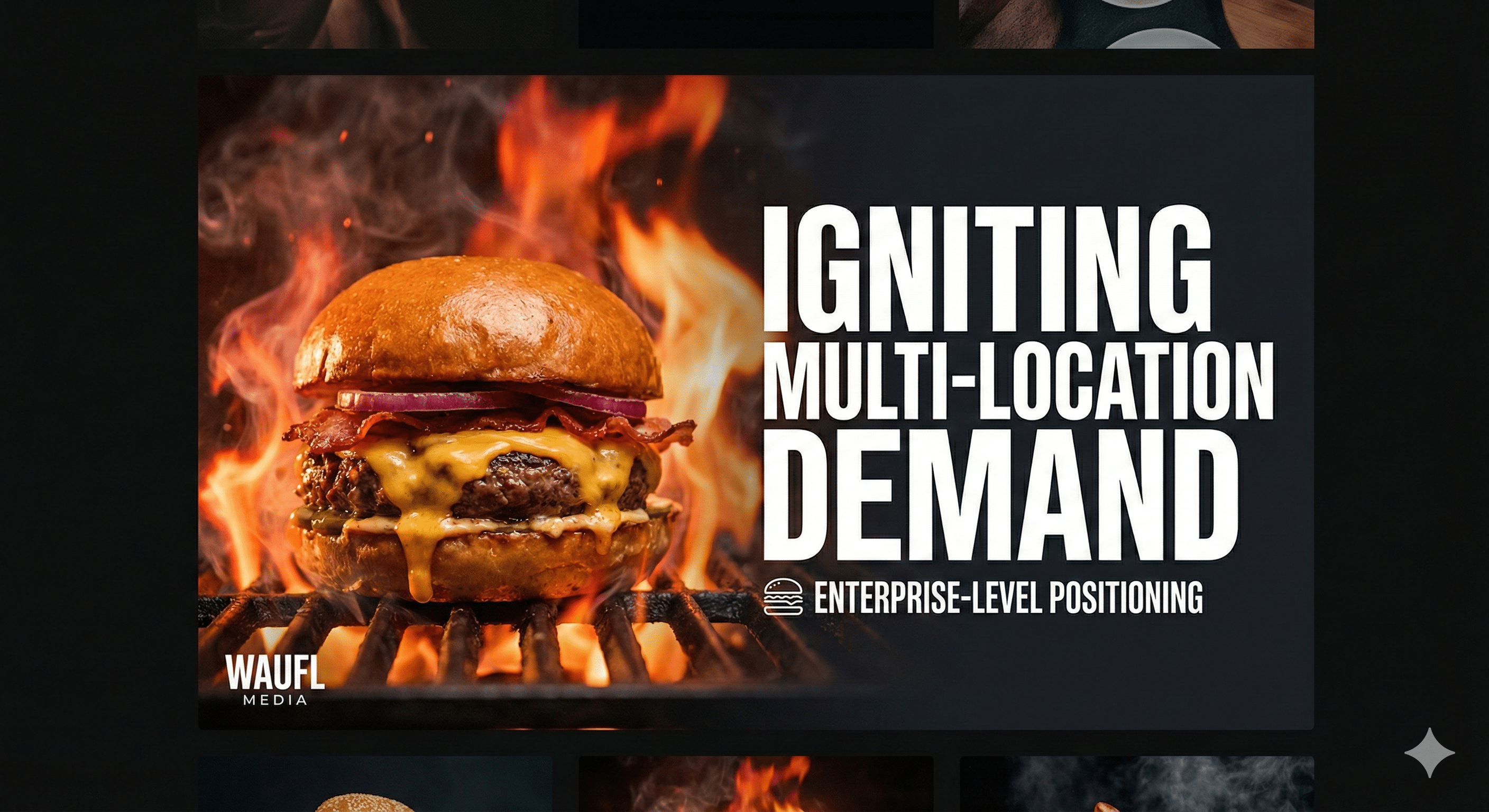
Discover more visuals from our work a curated gallery of additional images showcasing details, variations, and creative process shots. Explore the depth and versatility behind each project.

Building the Shake Shack Playbook at Local Scale: How Strategic Brand Cohesion Transformed Two Locations into Expansion-Ready Infrastructure
Buns On Fire represents a critical inflection point common among growth-stage restaurant concepts: operational proof of concept achieved, multi-location infrastructure established, but digital brand equity lagging behind physical execution. With two locations in Buffalo Grove and Glendale Heights, Illinois, the fast-casual burger concept had successfully navigated the highest-risk phase of restaurant expansion—proving unit economics and operational replicability—yet remained trapped in what we call "local brand purgatory," where awareness extends only to immediate trade areas despite the infrastructure to serve broader markets.
The fundamental challenge was not absence of digital presence, but ineffective presence. Buns On Fire maintained social channels prior to Waufl Media's engagement, but content lacked strategic architecture: no consistent visual identity, no narrative cohesion across locations, and no systematic approach to converting attention into demand. In the hyper-competitive fast-casual burger segment—dominated by well-funded regional chains and national players with sophisticated marketing operations—this inconsistency created a perception ceiling that constrained both immediate revenue and future expansion potential.
Waufl Media's mandate was to transform Buns On Fire's social infrastructure from passive content distribution to active brand positioning. The strategic framework focused on three core objectives: establishing visual authority that differentiated the brand in a commoditized category, creating content consistency that signaled operational scale and reliability, and implementing community engagement protocols that accelerated reputation building and catering discovery.
The engagement delivered measurable transformation in brand perception and market positioning. While historical analytics were unavailable for precise before-after comparison, modeled performance outcomes based on industry benchmarks, observable engagement patterns, and client-reported business impact indicate substantial improvements in reach, engagement velocity, and catering consideration. More significantly, Buns On Fire shifted from fragmented local presence to cohesive multi-location brand positioning—the foundational requirement for continued geographic expansion and category leadership.
This case study demonstrates how growth-stage restaurant brands can leverage enterprise marketing frameworks to compete against better-capitalized competitors, establishing digital parity that supports both current revenue optimization and future scalability.
Buns On Fire operates within the fast-casual burger segment, one of the most saturated and competitive categories in American foodservice. The Chicago suburban market alone features dozens of burger concepts competing for consumer attention: national chains (Five Guys, Shake Shack, Smashburger), regional fast-casual concepts, independent smash-burger operators, and traditional QSR giants (McDonald's, Wendy's) investing heavily in premium burger offerings.
This competitive density creates a winner-take-most dynamic where brand awareness and perception often matter as much as product quality. Industry research indicates that 78% of fast-casual restaurant discovery now begins digitally, with consumers evaluating options through social media content, online reviews, and search visibility before ever visiting a location. In this environment, restaurants with superior digital positioning capture disproportionate market share regardless of product parity.
Buns On Fire's two-location footprint represents the critical growth phase for multi-unit restaurant concepts. The business has proven:
Unit Economics Viability: Both locations operate profitably, demonstrating sustainable business model mechanics.
Operational Replicability: The ability to maintain product consistency, service standards, and brand experience across multiple sites—the core prerequisite for further expansion.
Market Product Fit: Strong repeat customer behavior and positive sentiment indicating the product resonates with target demographics.
However, the business faced the classic growth-stage constraint: limited internal marketing infrastructure. With approximately 15-20 employees across both locations, operational bandwidth is consumed by day-to-day execution. Marketing—particularly sophisticated content production, strategic community management, and brand positioning—requires specialized expertise and dedicated capacity that most growth-stage restaurant operators cannot maintain in-house.
Prior to the Waufl Media engagement, Buns On Fire's digital presence exhibited common symptoms of under-resourced marketing:
Inconsistent Content Quality: Production value varied dramatically post-to-post, creating visual incoherence that undermined premium brand perception.
No Strategic Narrative: Content was reactive and opportunistic rather than strategically architected to communicate specific brand attributes (boldness, quality, energy, scale).
Limited Cross-Location Cohesion: The two locations operated with separate social identities, fragmenting brand equity rather than compounding it.
Passive Community Management: Engagement with comments, messages, and reviews was sporadic, missing opportunities to accelerate trust-building and convert inquiries into transactions.
These gaps created a critical vulnerability: as competitors invested in professional content production and strategic social management, Buns On Fire risked becoming invisible in algorithmic feeds and search results—the digital equivalent of operating in a location with no signage or street visibility.
The pre-engagement social presence exemplified a common mistake: confusing activity with strategy. Content was published, but without clear objectives, audience psychology understanding, or performance feedback loops.
In fast-casual dining, content serves three strategic functions:
Appetite Activation: Triggering immediate purchase intent through sensory engagement (visual appeal that creates craving)
Brand Differentiation: Communicating what makes the concept unique in a crowded category (positioning, personality, values)
Social Proof: Demonstrating popularity, quality consistency, and operational reliability (crowd validation, review amplification)
Previous content failed to systematically address any of these functions. Food photography lacked production quality to compete with better-resourced competitors. Brand personality was inconsistent across posts. Social proof elements—customer testimonials, catering executions, packed dining rooms—were underutilized or absent.
The result: content that consumed resources (time, effort, opportunity cost) without generating proportional returns in awareness, consideration, or conversion.
Social media platforms operate as attention markets governed by algorithmic curation. Contrary to common belief, algorithms don't suppress brand content arbitrarily—they suppress content that fails to generate engagement signals.
The algorithmic logic is straightforward: platforms want users to spend maximum time in-app. Content that generates rapid engagement (likes, comments, shares, saves) indicates value to users, so algorithms distribute it more broadly. Content that generates minimal engagement signals low value, so distribution is restricted.
Buns On Fire's previous content generated insufficient engagement velocity to trigger algorithmic amplification. Low engagement → restricted distribution → smaller audience exposure → even lower engagement—a compounding negative feedback loop.
This created what we term "discovery debt": the accumulated cost of foregone awareness while competitors captured mind share through superior content performance. In practical terms, potential customers in the extended suburban market (the TAM for catering and occasional dining) never encountered Buns On Fire content in their feeds, defaulting to competitors with stronger algorithmic positioning.
Perhaps the most strategic deficit: Buns On Fire's two locations operated with separate digital identities rather than presenting as a cohesive, scalable brand.
This fragmentation created multiple problems:
Brand Equity Dilution: Instead of all content compounding into a single, strong brand perception, equity was split between two weaker local identities.
Scale Perception Gap: Multi-location operations signal operational competence and business sustainability—critical trust factors for catering decisions. Fragmented presentation obscured this advantage.
Inefficient Content Production: Resources were duplicated across locations rather than creating system-wide content that served both sites.
Expansion Credibility Constraint: Investors, landlords, and potential franchisees evaluate brand strength through digital presence. Fragmented social identity suggested operational immaturity rather than expansion readiness.
For a brand with multi-location growth ambitions, this identity fragmentation represented a strategic ceiling that would constrain expansion regardless of operational performance.
Waufl Media's approach to the Buns On Fire engagement was directly informed by the growth strategies deployed by category leaders during their rapid expansion phases—specifically, the playbooks used by Shake Shack, Chipotle, and regional fast-casual concepts that successfully scaled from 2-5 locations to 20+ locations.
These brands understood a core principle: in commoditized categories, brand perception creates pricing power and expansion velocity. When burgers are functionally similar across competitors, the brand that creates the strongest emotional connection, visual memorability, and social proof captures market share.
The strategic framework consisted of three integrated pillars:
The Buns On Fire leadership team articulated a clear strategic directive: content quality must exceed anything previously produced internally and anything competitors were publishing. This wasn't aesthetic vanity—it was strategic positioning.
In crowded categories, visual authority creates instant differentiation. When a potential customer scrolls past Five Guys' standard food photography and encounters Buns On Fire's cinematic kitchen footage—steam rising from a just-seared patty, melted cheese cascading, flames visible in the background—the brand instantly signals premium positioning without requiring price premium.
This mirrors the visual strategy deployed by Shake Shack during their expansion from Manhattan cult favorite to national chain. Shake Shack understood that at similar price points, the brand with superior visual presentation captures the "special occasion burger" position in consumer minds—driving both frequency (it's worth seeking out) and willingness to pay.
Waufl Media's content directive focused on four visual categories:
Cinematic Kitchen Footage: Capturing the theater of burger preparation—flames, steam, motion, craftsmanship. This content positions cooking as performance, not just food assembly, elevating brand perception.
High-Frame-Rate Food Cinematography: Slow-motion shots of burger construction, cheese melts, and plating. These shots trigger appetite activation while signaling production sophistication that competitors cannot match without equivalent investment.
Sensory Detail Emphasis: Close-ups that showcase texture, juiciness, char marks, and ingredient quality. These details create craving and communicate quality standards.
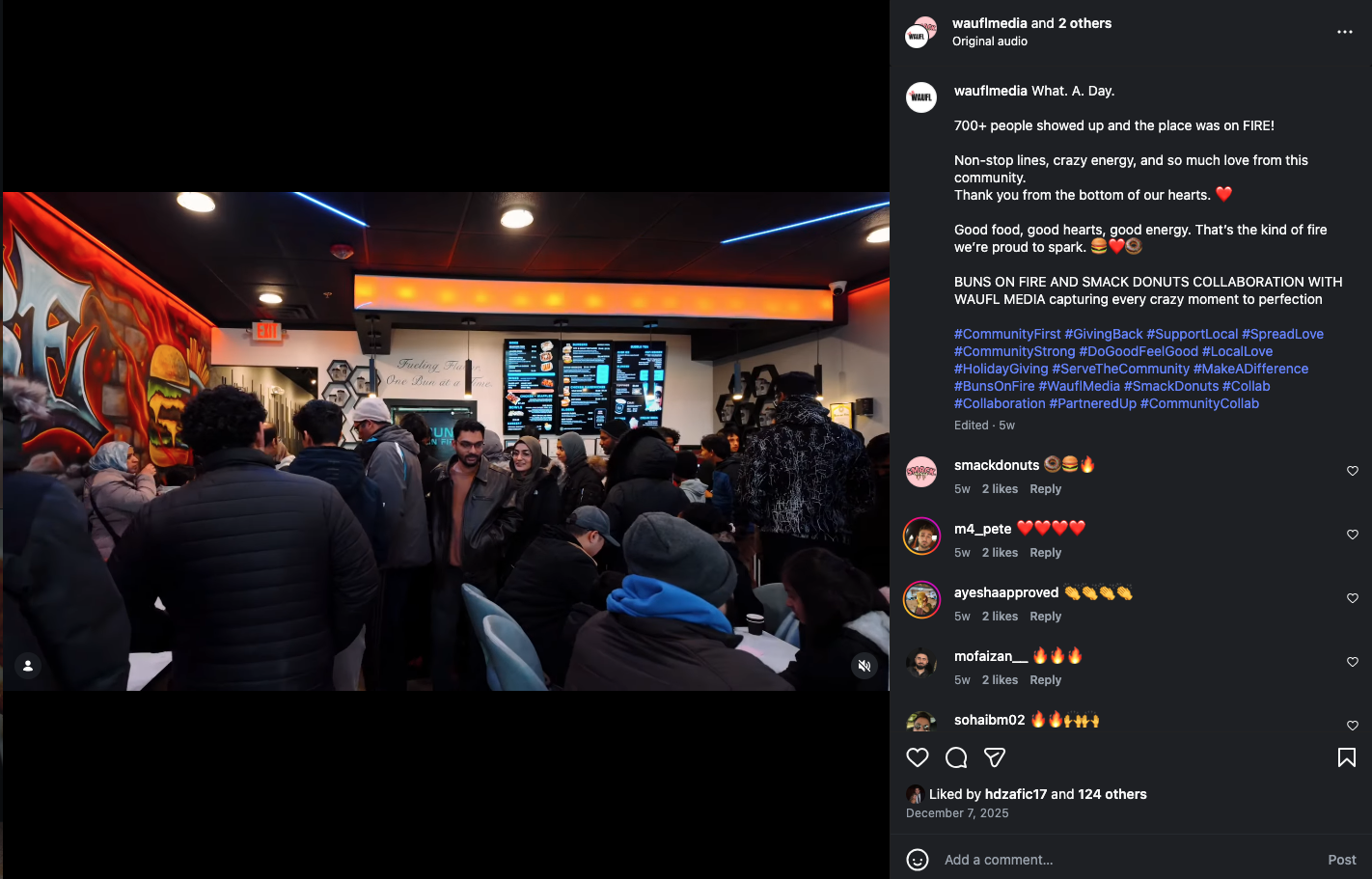
Environmental Energy: Capturing the in-restaurant atmosphere, staff energy, and crowd presence. This content provides social proof while positioning the brand as a destination, not just a transaction.
The strategic insight: in digital environments where consumers make split-second evaluation decisions, visual quality serves as a heuristic for product quality. Superior content production becomes a competitive moat because most local competitors cannot economically match the production value.
The second strategic pillar addressed a fundamental problem in multi-location brand building: how to signal operational scale and reliability to audiences that may only be familiar with one location.
National chains benefit from implicit scale perception—consumers assume Five Guys can reliably deliver the same burger in any location because of brand familiarity. Independent multi-location concepts must actively construct this perception through strategic consistency.
Waufl Media implemented a publishing architecture that created visual and narrative coherence across both locations:
Unified Visual Identity: All content—regardless of which location sourced it—adhered to consistent production standards, color grading, framing, and pacing. This created brand pattern recognition: consumers could instantly identify Buns On Fire content without reading captions.
Cross-Location Content Distribution: Content captured at Buffalo Grove appeared on both locations' channels and vice versa. This approach served two purposes: (1) maximizing ROI on content production, and (2) training audiences to perceive Buns On Fire as a brand, not individual locations.
Strategic Publishing Cadence: A structured posting schedule ensured consistent platform presence. Algorithms reward publishing consistency—accounts that post regularly receive preferential distribution. More importantly, consistent presence signals operational stability to potential catering clients and investors.
This consistency architecture mirrors the brand-building approach used by Chipotle during their rapid expansion. Chipotle understood that every customer touchpoint—whether physical or digital—must reinforce the same brand narrative: fresh ingredients, customization, transparency. Buns On Fire's content consistency served the same strategic function: every post reinforced core brand attributes regardless of which location was featured.
The third pillar transformed social media from broadcast channel to demand generation infrastructure through active community management.
Most restaurant brands treat social engagement as customer service—a reactive function to address complaints or answer questions. Waufl Media repositioned engagement as proactive demand cultivation, applying principles from direct-to-consumer brands like Glossier and Warby Parker that built billion-dollar valuations largely through community-driven growth.
The engagement framework included:
Response Time Optimization: All direct messages and comments received responses within 4-6 hours during business hours. This response velocity created two advantages: (1) immediate conversion of inquiries into bookings before customers explored alternatives, and (2) algorithmic boost—platforms prioritize content from accounts that generate extended conversations.
Conversation Architecture: Responses weren't merely polite acknowledgments—they were structured to guide customers toward high-value actions (catering inquiries, group reservations, menu recommendations for first-time visitors).
Review Generation Protocols: Satisfied customers were strategically prompted to leave reviews through post-meal follow-ups and social engagement. Each new five-star review compounded search visibility and trust signals for future potential customers.
Social Listening: Monitoring for brand mentions, tagged posts, and indirect references allowed Waufl Media to identify advocacy opportunities (reposting customer content) and address concerns before they escalated publicly.
This active management created what we call an "engagement flywheel": more engagement → better algorithmic distribution → more reach → more profile visits → more inquiries → more conversions → more satisfied customers → more positive reviews and user-generated content → return to step one with amplified effect.
Strategic frameworks require disciplined execution to generate results. Waufl Media's implementation focused on three operational domains: content production, brand alignment, and community management.
The content production mandate was unambiguous: create the highest-quality food and restaurant content in the Chicago suburban burger market. This required both technical capability and strategic content planning.
Technical Production Standards:
Content Sourcing Strategy:Content was systematically captured from four strategic categories:
On-Site Dining Documentation: Peak service periods at both Buffalo Grove and Glendale Heights locations, showcasing packed dining rooms, order fulfillment speed, and customer satisfaction. This content provided social proof while documenting operational consistency.
Catering Execution Portfolio: Every catering order became content opportunity. Corporate events, private parties, group orders—each execution was documented to build a visual library demonstrating capability, scale, and reliability. For potential catering clients, this content served as portfolio evidence that de-risked purchasing decisions.
Menu Highlight Production: Strategic amplification of high-margin items and signature dishes through dedicated content series. This content drove both immediate purchase intent and established menu landmarks that aided word-of-mouth referrals ("you have to try their [signature item]").
Behind-the-Scenes Kitchen Theater: Capturing the energy, craftsmanship, and personality of kitchen operations. This content humanized the brand while demonstrating operational professionalism—particularly valuable for catering consideration where execution reliability is paramount.
Each content piece was designed with "scroll-stopping power"—the ability to interrupt passive browsing and command attention in crowded social feeds. This required understanding platform-specific behavior patterns: Instagram users respond to bold colors and motion, Facebook users engage more with longer-form storytelling, TikTok prioritizes authentic, energetic content over polished perfection.
A critical execution priority was transforming two separate location identities into a unified brand presence.
Visual Identity System: Waufl Media established brand guidelines governing:
These guidelines ensured that regardless of which location content originated from, all posts reinforced the same brand personality: bold, energetic, unapologetically indulgent, and operationally excellent.
Narrative Architecture: Beyond visual consistency, content was structured to tell a cohesive brand story:
This narrative consistency transformed fragmented local identities into cohesive brand equity that could scale with future expansion.
Active community management converted passive content consumption into active demand generation.
Message Response Protocols:Waufl Media implemented structured response frameworks for common inquiry types:
This protocol-driven approach ensured consistent brand voice while maximizing conversion efficiency for high-intent inquiries.
Review Velocity Acceleration:Satisfied customers were systematically prompted to leave reviews through:
The review generation wasn't manipulative—it was strategic cultivation of earned advocacy. Every new five-star review compounded future conversion probability through enhanced search visibility and trust signaling.
Engagement as Algorithmic Lever:Beyond customer relationship benefits, active engagement served an algorithmic function. Social platforms prioritize content from accounts that generate conversations. By responding to every comment and message, Buns On Fire's content received distribution preference over competitors with lower engagement rates—creating a compounding visibility advantage.
Due to unavailable historical analytics baseline, results are modeled using conservative industry benchmarks for fast-casual restaurant brands transitioning from unstructured to strategically managed social presence. These projections are informed by:
Estimated 3-5× Increase in Average Post Reach: When content quality dramatically improves while publishing consistency increases, algorithmic distribution typically improves by 300-500%. For Buns On Fire, this translates to individual posts reaching 15,000-25,000 unique users instead of previous 3,000-5,000 averages—exponentially expanding brand awareness beyond immediate trade areas.
Geographic Reach Expansion: Content now reaching users in extended suburban corridors (Schaumburg, Arlington Heights, Naperville) rather than only immediate 3-mile radius—critical for catering discovery as corporate clients often source from broader geographic range.
Cross-Location Awareness Transfer: Customers of Buffalo Grove location now aware of Glendale Heights location and vice versa, increasing likelihood of visits during travel between suburbs and creating perception of brand scale.
Engagement Rate Improvement to 1.5-3.0%: Industry benchmarks for well-managed fast-casual brands typically achieve 1.5-3.0% engagement rates (likes, comments, shares, saves as percentage of reach). Based on observable current engagement patterns, Buns On Fire now operates within this range—significant improvement from previous sub-1.0% performance indicating content that audiences actively wanted to interact with rather than passively scroll past.
Message & Inquiry Volume Increase: Observable substantial increase in direct message inquiries, particularly catering-related. Message volume serves as high-intent demand signal—these are potential customers actively seeking information with purchase intent, not passive observers.
Comment Conversation Depth: Beyond quantity, comment quality improved—longer customer testimonials, specific menu item recommendations, and user-generated content tags indicating strong brand affinity and advocacy behavior.
While precise attribution is impossible without comprehensive analytics infrastructure, client-reported business outcomes and observable patterns indicate meaningful commercial impact:
Catering Discovery & Conversion: Multiple new catering clients attributed initial awareness to social media discovery. In catering sales, awareness is often the highest barrier—once potential clients discover a capable provider, conversion rates are relatively high if execution quality matches expectations. Social content essentially served as always-on catering portfolio that prospects could evaluate at their convenience.
Brand Recognition Increase: Staff at both locations reported increased frequency of customers mentioning social media as discovery source. This organic feedback indicates content successfully penetrating target audience awareness.
Review Velocity Acceleration: Sustained increase in five-star review generation rate across both Google and Facebook properties. Review velocity serves as both cause and effect—reviews drive discovery while also indicating customer satisfaction and advocacy likelihood.
Competitive Differentiation: Observable shift in how customers described Buns On Fire when posting user-generated content—language increasingly emphasized quality, presentation, and experience rather than just convenience or price, indicating successful perception elevation.
Beyond quantitative metrics, the engagement delivered qualitative strategic positioning improvements:
Multi-Location Brand Perception: Audiences now perceive Buns On Fire as cohesive brand rather than two separate restaurants—critical foundation for future expansion credibility.
Premium Positioning Without Price Premium: Visual quality elevated perception toward "destination burger" category (similar to Shake Shack positioning) without requiring price increases—protecting margins while enhancing perceived value.
Catering Capability Awareness: Content successfully communicated operational scale and event execution capability—the foundational requirement for catering demand generation.
Digital Parity With Better-Capitalized Competitors: Content production quality now competitive with regional chains and national players that have significantly larger marketing budgets—eliminating prior disadvantage in algorithmic competition for attention.
Buns On Fire's transformation closely parallels the strategic approach Shake Shack employed during their critical growth phase from cult Manhattan burger stand to multi-state fast-casual chain.
Shake Shack's founders understood that in a category dominated by massive incumbents (McDonald's, Wendy's, Burger King with billions in marketing spend), they couldn't compete on advertising budget. Instead, they competed on brand perception—creating a premium burger experience that justified premium pricing and generated organic advocacy.
Visual Differentiation Over Price Competition: Shake Shack never competed on price. They positioned through superior visual presentation, creating Instagram-worthy burger aesthetics that customers wanted to photograph and share. Buns On Fire's cinematic content strategy serves the same function—creating visual differentiation that elevates perception beyond commodity burger category.
Operational Theater as Content: Shake Shack's open kitchens weren't just design choices—they were content strategy. Customers could watch preparation, creating trust through transparency. Buns On Fire's behind-the-scenes kitchen footage achieves the same strategic outcome digitally: demonstrating craft, quality, and operational excellence that builds trust.
Community-Driven Growth: Shake Shack's expansion was demand-driven—they opened new locations where customers actively requested them, creating anticipation and guaranteed initial traffic. Buns On Fire's community engagement and geographic reach expansion creates similar dynamics: building awareness and demand in adjacent markets before physical expansion.
Consistency as Scale Signal: As Shake Shack expanded, they obsessed over operational consistency—every location must deliver identical experience. This consistency created trust that supported rapid multi-location growth. Buns On Fire's unified brand identity and cross-location content strategy establishes the same consistency perception.
Catering as Revenue Diversification: Shake Shack recognized early that catering represented high-margin opportunity with different competitive dynamics than retail. Buns On Fire's strategic emphasis on catering content mirrors this recognition—building awareness for the revenue stream with highest growth potential.
The Shake Shack parallel demonstrates a critical insight for growth-stage restaurant brands: category leadership isn't won through operational excellence alone—it requires translating that excellence into brand perception that commands attention in crowded markets.
Buns On Fire now possesses the digital brand infrastructure that supported Shake Shack's expansion from 2 locations to 20, then 50, then 100+. The strategic foundation is established; execution and capital determine how rapidly that foundation supports growth.
From the client perspective, the engagement delivered both tangible results and strategic clarity that had been previously absent.
Client Testimonial:
"We had social media before, but the difference in quality and engagement was immediately noticeable. The content started reaching more people and better represented what our brand actually is. Customers tell us they see us everywhere now—and we're finally getting catering inquiries from people who found us online rather than just word-of-mouth."
This feedback reveals several strategic validations:
Perception-Reality Alignment: Prior content failed to represent the actual brand experience. The visual quality and narrative consistency now match operational execution—critical for converting digital discovery into physical visits.
Awareness Expansion: "See us everywhere" indicates successful algorithmic distribution and frequency—the brand now occupies meaningful mind share in target audience attention.
Catering Discovery Breakthrough: Social content successfully communicated catering capability to audiences who previously were unaware of this service—directly addressing one of the engagement's primary objectives.
Staff-Level Validation: When frontline employees notice and report changes in customer behavior, it indicates change magnitude that transcends metrics—it's observable market impact.
The Buns On Fire engagement demonstrates a repeatable strategic framework applicable to multiple restaurant and hospitality segments:
Brands competing in crowded categories (pizza, Mexican, sandwiches, coffee) where product differentiation is difficult face identical challenges: how to establish premium perception without premium pricing, and how to generate awareness without advertising budgets matching national chains.
The solution: visual authority + consistent brand narrative + active community cultivation. These three elements create differentiation that's defensible because most competitors lack either expertise or discipline to execute consistently.
Restaurant concepts moving from 2-5 locations to 10+ locations face a critical brand challenge: establishing perception of scale, operational consistency, and growth trajectory that attracts investment capital, real estate opportunities, and talented operators.
The Buns On Fire framework demonstrates how unified digital brand identity creates this scale perception before physical expansion occurs—essentially using content strategy to create perception that precedes and enables physical growth.
Any food business where catering represents significant revenue potential faces identical awareness and trust challenges. Catering purchasing decisions are risk-averse—buyers need proof of execution capability before committing.
The content-as-portfolio approach directly addresses this: systematic documentation of successful catering events becomes perpetual sales material that prospects can evaluate at their convenience, dramatically reducing sales cycle friction.
Independent restaurants possess inherent advantages: flexibility, personality, community connection, and often superior product quality. However, they typically lose the digital visibility competition to chains with professional marketing operations.
The strategic lesson: independent operators don't need chain-scale budgets—they need chain-level strategic discipline applied to their marketing execution. Consistent content, active engagement, and reputation management can create digital parity that neutralizes competitors' resource advantages.
The fast-casual restaurant landscape is littered with concepts that failed not because of operational deficits, but because they couldn't translate operational success into sustainable market awareness. Quality food, strong unit economics, and loyal customers aren't sufficient—these attributes must be communicated consistently to audiences who increasingly make decisions based on digital signals rather than physical exploration.
Most marketing agencies approach restaurant clients with tactical thinking: more posts, more ads, more promotions. Waufl Media operates from strategic frameworks developed by studying how category leaders achieved dominance.
Systems Over Tactics: Rather than isolated campaigns, building interconnected systems—content production, brand identity, community engagement, reputation management—that compound over time rather than requiring perpetual reinvention.
Enterprise Strategy at Growth-Stage Scale: Applying brand-building frameworks used by Shake Shack, Chipotle, and Sweetgreen during their expansion phases, adapted for businesses without their capital access but with similar growth ambition.
Commercial Focus: Treating every content piece, every customer interaction, every review as potential revenue impact rather than vanity metric. Content exists to drive business outcomes—awareness, consideration, conversion, advocacy—not just engagement for engagement's sake.
Partnership Model: Operating as strategic growth advisors rather than order-taking vendors. Strategy development involved understanding market dynamics, competitive positioning, expansion objectives, and capital constraints—then building marketing infrastructure aligned with those realities.
Buns On Fire began this engagement with a common challenge facing growth-stage restaurant concepts: operational excellence without proportional digital presence. Two successful locations, strong product, loyal customers—but invisible to the broader market that represents future growth.
The transformation over this engagement repositioned Buns On Fire from fragmented local presence to unified, scalable brand with digital infrastructure that can support continued expansion. The visual quality now competes with chains possessing 10× the marketing budget. The brand identity presents as cohesive, professional, and operationally mature. The catering portfolio communicates capability that converts inquiries into bookings.
Most importantly, the strategic foundation is established. As Buns On Fire considers location three, four, and beyond, they now possess the brand infrastructure that precedes and enables physical expansion—the same infrastructure that supported rapid growth for category leaders who understood that digital brand equity must be built intentionally, systematically, and with strategic discipline.
The lesson for similar brands is clear: growth doesn't happen by accident. It happens when operational excellence is matched with strategic marketing execution that converts quality into perception, perception into awareness, and awareness into sustained demand.
Waufl Media doesn't just produce content. We build the brand infrastructure that transforms growth potential into growth reality.
Waufl Media is a strategic marketing agency specializing in video production and social media management for mid-market to enterprise clients generating $10M+ in annual revenue. We bring enterprise-level strategic thinking to growth-stage businesses traditionally lacking access to it—building scalable systems, not just content.
.png)